

Travel in Pathalis is shaped by access, cost, and choice.
Portals exist. Airships are common. Roads still matter. None of these replace the others entirely. Instead, people move by weighing convenience, expense, safety, and purpose-often all at once. Distance no longer isolates the world, but it still shapes how people live within it.
Both land portals and sky portals are widely used throughout Pathalis.
They are not rare or elite tools. Prices are deliberately set to remain accessible to common travelers, merchants, workers, and pilgrims. Booking passage through a portal—on foot, by wagon, or aboard an airship—is a normal part of life.
For most citizens, portal travel is feasible, not luxurious.
That said, portals are not everywhere.
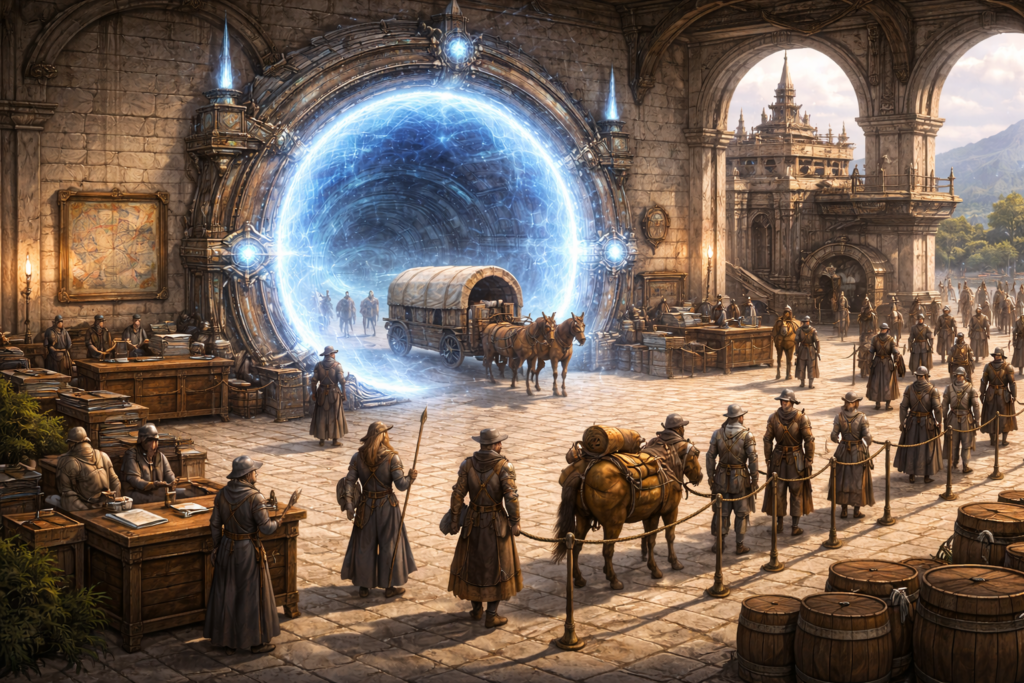
Portals require constant maintenance, oversight, and traffic to remain operational.
Smaller towns and remote settlements often lack portals not because they are forbidden, but because they cannot generate enough consistent use to justify the cost. As a result:
- Major cities function as portal hubs
- Trade routes form between portals and smaller towns
- Travel between a portal and a final destination is still required
This creates a layered travel system: rapid movement between hubs, followed by slower, more vulnerable journeys outward.
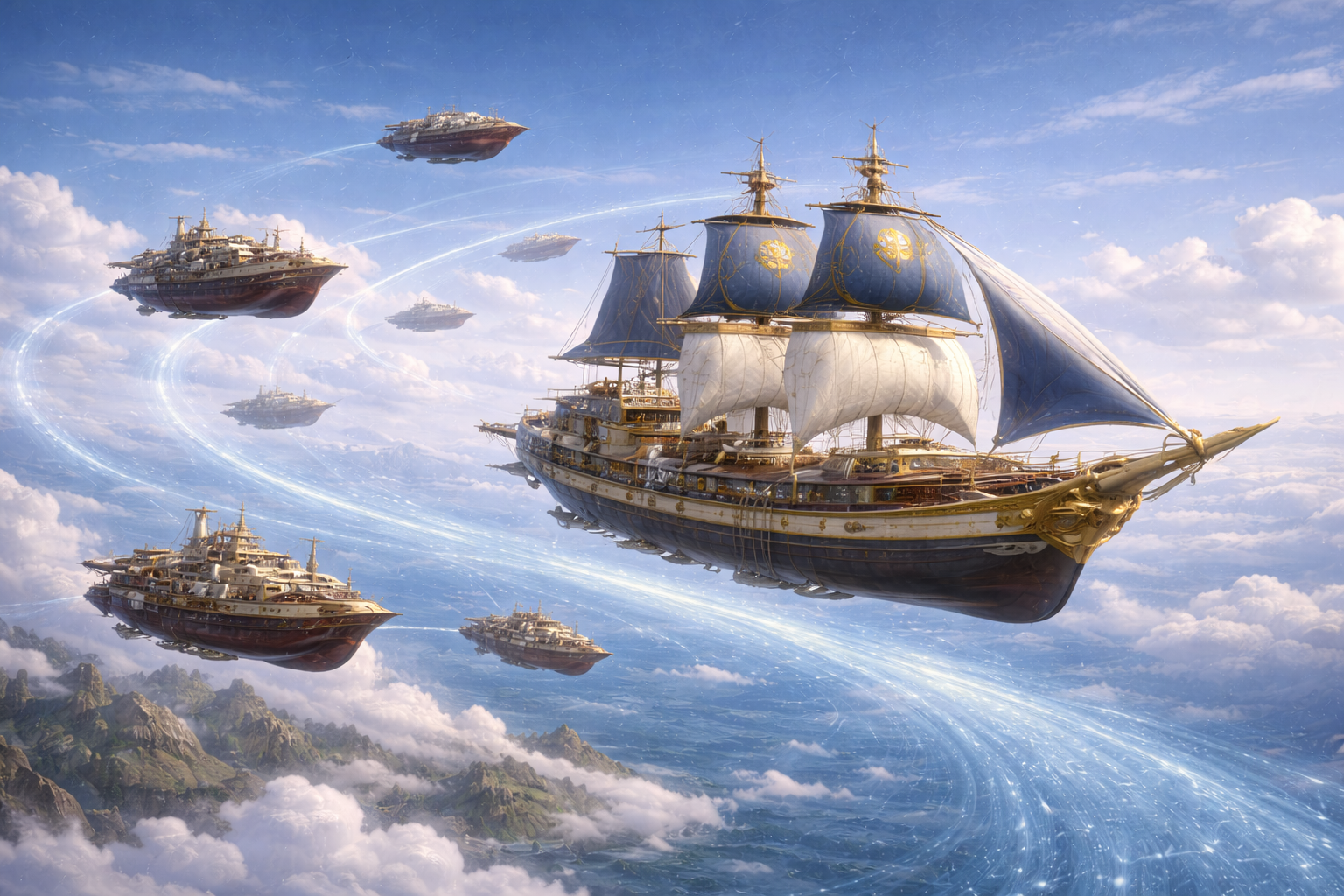
Air travel is the backbone of movement across Pathalis.
Airships are not a novelty. They are tools used daily by merchants, couriers, labor crews, travelers, and private citizens. The sheer variety of airship design reflects the variety of needs they serve.
There are as many kinds of airships as there are ships on the sea.
Airships range dramatically in size and purpose.
Some are little more than airborne equivalents of canoes—small, lightly crewed craft meant for short hops. Others rival luxury liners, carrying hundreds of passengers, massive cargo holds, and full service crews.
Between these extremes exist countless designs:
- Personal skiffs
- Merchant haulers
- Passenger ferries
- Patrol and escort vessels
- Luxury liners
- Converted cargo rigs
- Experimental and hybrid ships
No single design dominates. Local materials, engineering traditions, and intended use shape each vessel.
▸ Methods of Propulsion
Airships are defined as much by how they move as by their size.
Common propulsion methods include:
- Oars or tread-driven systems for short-range craft
- Sails that catch stable air currents and sky lanes
- Mechanical engines, loud but reliable
- Purely magical lift and thrust systems
- Steampunk and gearpunk designs using pressure and pistons
- Hybrid magic–technology systems blending arcane stabilization with machinery
Most travelers recognize a ship’s propulsion long before they recognize its owner.
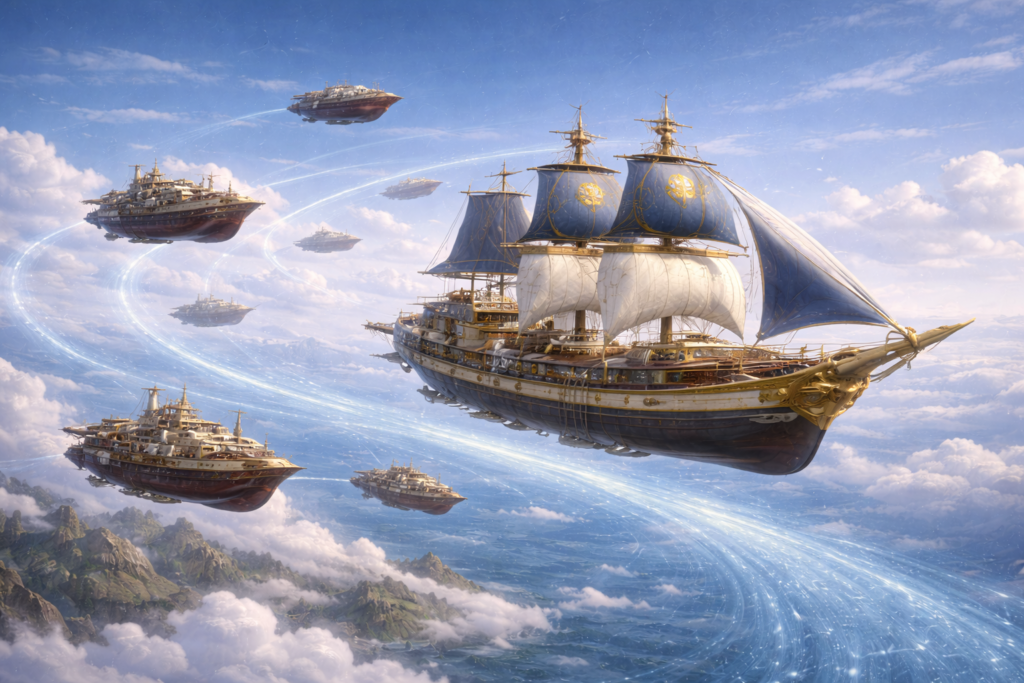
Booking passage on an airship is common and affordable.
Larger ships offer safety in numbers, predictable schedules, and greater comfort. Smaller ships trade that security for speed, discretion, or lower cost.
Air travel is generally reliable, but not without risk. Weather shifts, mechanical failure, sky creatures, piracy, and privateers are all known hazards. Ships traveling alone are more vulnerable than those moving in convoys or under escort.
Reputation matters. Ships known for reliability fill faster than those that cut corners.
▸ Overland Travel and Cargo
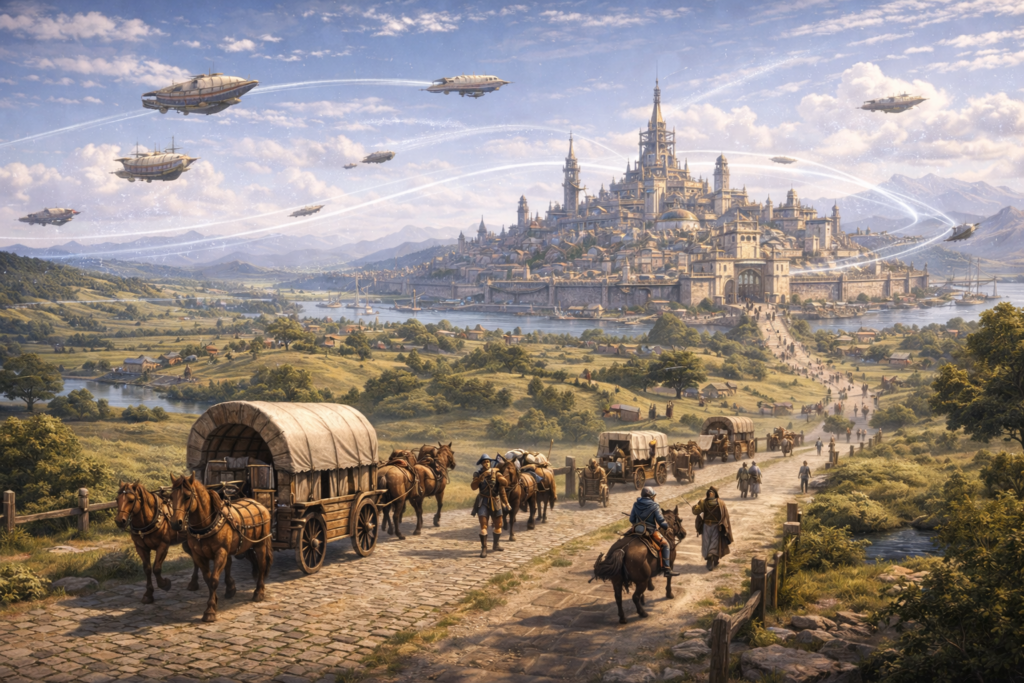
For travelers moving wagons, livestock, or bulk goods, portals are not always economical.
The cost of transporting large loads through a portal may outweigh the benefit, especially over short distances. In these cases:
- Goods move by road or river
- Travelers join caravans for safety
- Guards or escorts are hired when necessary
Overland travel remains essential to Pathalis’s economy, even in a world of portals and airships.
Bandits operate along roads between hubs. Risk is understood and factored into travel decisions.
▸ Water Travel
Water travel exists—but it is secondary.
Rivers and Bays
Boats are commonly used along rivers, lakes, and sheltered bays. These routes support local trade, fishing, and regional movement where portals are impractical.
The Open Ocean
True ocean travel is rare. Long-distance sea voyages are viewed as impractical, unnecessary, or quietly dangerous. Trade, migration, and exploration overwhelmingly favor air routes instead.

Most people in Pathalis travel along established routes.
Sky lanes, portal hubs, maintained roads, and escorted corridors exist for a reason: they are predictable, regulated, and comparatively safe. Commerce depends on them. Governments monitor them. Most citizens never leave them.
But the world is larger than its routes.
▸ Travel Off the Map
Beyond the known paths lies land that is rarely traveled and even more rarely recorded.
Old roads fade. Trails vanish. Airship charts thin. Portals do not exist where traffic cannot sustain them. Vast stretches of Pathalis remain functionally unexplored, not because they are unreachable—but because they are inconvenient, dangerous, or unprofitable.
▸ Rumors, Ruins, and Discovery
Stories circulate of:
- Ruins untouched for generations
- Cities swallowed by forest or stone
- Relics abandoned when routes shifted
- Structures that predate modern records
- Places that appear on no official map
Most stories are exaggerated. Some are false. A few are true.
▸ Who Leaves the Routes
Those who leave established paths do so deliberately.
Treasure hunters, explorers, scholars, scavengers, and adventurers travel by foot or mount, carrying supplies instead of tickets. They move slowly, cautiously, and often without certainty of return.
Because so few people explore the land anymore, those who do still have a genuine chance to find something new.
Not rediscovered.
New.
▸ How Travel Shapes the World
Because portals and airships favor hubs:
- Cities grow where traffic concentrates
- Small towns persist between routes
- Taverns, outposts, and sky stations thrive as connectors
- Information travels quickly—but unevenly
Pathalis is connected without feeling small.
▸ What Travelers Learn
- Portals save time, not judgment
- Safety comes from numbers and reputation
- Distance still costs something—if not time, then coin
- Maps show where people go, not everything that exists
In Pathalis, movement is easy.
Discovery is not.