



Pathalis is not ruled by a single crown, faith, or empire.
Authority here is layered, negotiated, and enforced through institutions rather than divine mandate. Power flows through councils, guilds, contracts, and armed force, often overlapping rather than replacing one another.
Order exists—but it is maintained deliberately, not assumed.
Central Authority
At the highest visible level, Pathalis is governed by the Council of Nine.
The Council functions as a continental governing body, setting broad policy, resolving large-scale disputes, and maintaining stability between major cities and regions. Its authority is widely recognized, even in places that resent its influence.
The Council does not rule daily life. Instead, it establishes frameworks—laws, treaties, and enforcement powers—that local governments are expected to follow, adapt, or formally contest. Most citizens never interact with the Council directly, but its decisions shape trade, travel, and security across the world.
Law Enforcement and Order
Enforcement of law in Pathalis varies by region, but the most visible force associated with continental authority is the Meshen Guard.
The Meshen Guard operates primarily in and around major cities, trade corridors, and sites of strategic importance. They are tasked with maintaining order, enforcing Council law, and responding to threats that exceed local capacity.
Outside these areas, towns and settlements often maintain their own guards or militias. These local forces handle everyday disputes, minor crimes, and customary law, deferring to larger authorities only when necessary.
Justice in Pathalis prioritizes stability over punishment. Fines, restitution, enforced service, and exile are more common than long-term imprisonment, especially beyond major cities.
Military Authority
Order in Pathalis is not maintained by a single standing army. Instead, decisive force is applied selectively, visibly, and with intent.
Two instruments of authority are recognized across the world: the Warforged legions and the Council’s Armada.
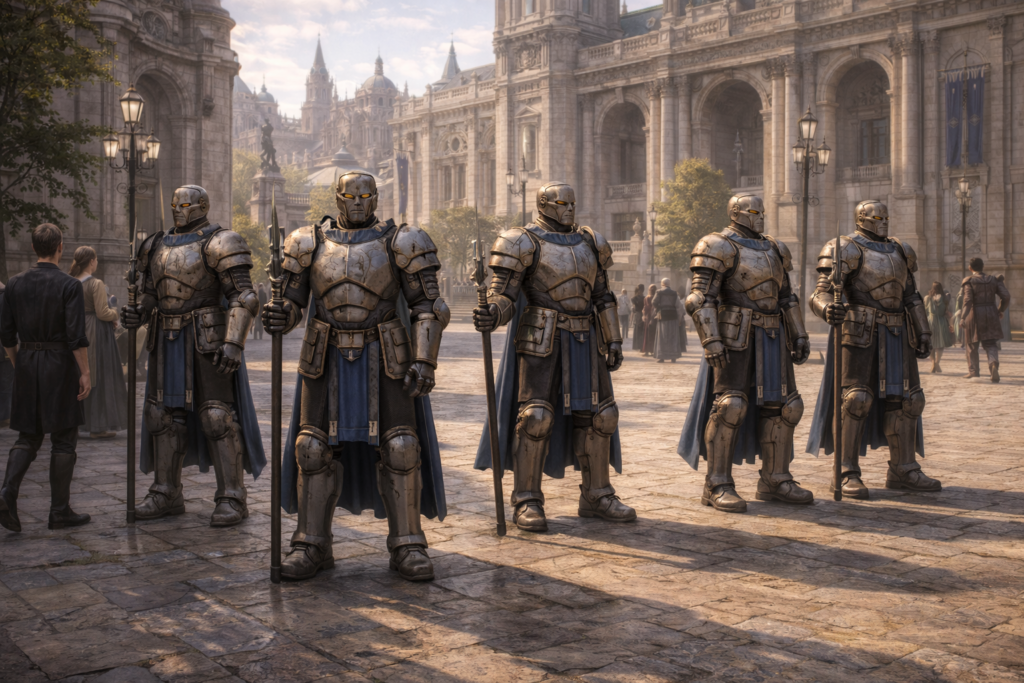
Warforged Legions
Warforged are constructed soldiers created for the explicit purpose of enforcement and warfare. They are not civilians, citizens, or common guards. Their presence signals state-level intervention rather than routine lawkeeping.
To most people, Warforged represent inevitability rather than cruelty. They are deployed where conventional forces would falter or where escalation must be unmistakable. Their appearance alone is often enough to suppress unrest or end disputes.
Warforged do not patrol casually, nor do they involve themselves in local matters unless ordered. When they arrive, it is understood that a situation has exceeded local authority.
The Council Armada
The most visible symbol of continental power is the Council’s airship fleet, commonly referred to as the Armada.
The Armada operates above cities, trade corridors, and contested regions, projecting authority through presence rather than constant engagement. Its ships are unmistakable and intentionally public, serving as both deterrent and reassurance depending on who is watching.
While individual cities maintain their own defenses and patrol craft, the Armada answers directly to the Council and acts when regional stability, major trade routes, or Council authority itself is threatened.
For most citizens, the Armada is something seen from below—silent, distant, and impossible to ignore.

Sanctioned Intervention
Not all authority in Pathalis is enforced through soldiers or fleets.
Some problems require discretion, adaptability, and limited visibility. These are handled through sanctioned intervention rather than open force.
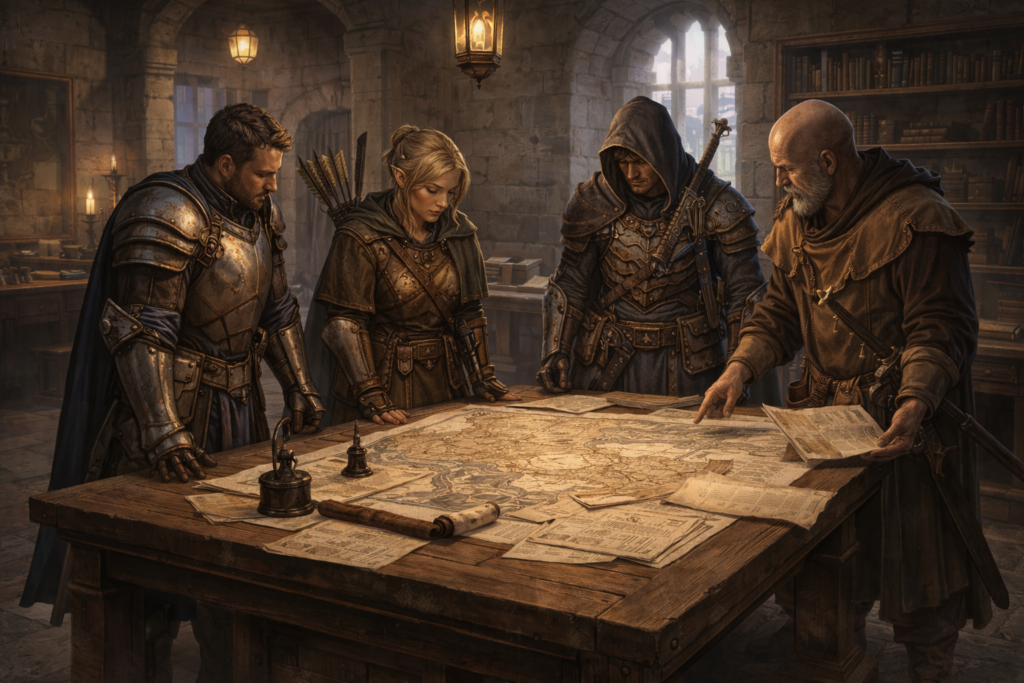
The University and Cadres
The The University serves as the primary training ground for cadres—small, specialized teams prepared to handle situations beyond the scope of ordinary law enforcement.
Cadres are not mercenaries in the traditional sense. They operate under formal contracts, are subject to oversight, and are deployed to resolve specific problems rather than wage open war. Cities, guilds, and governing bodies hire cadres when conventional solutions are insufficient, politically sensitive, or time-critical.
To the public, cadres are seen as stabilizers: individuals or teams who arrive quietly, resolve a problem, and depart before larger forces become necessary.
Authority Through Contract
Cadre authority does not come from rank or uniform, but from legal mandate.
When a cadre is contracted, their actions carry the weight of the agreement that empowered them. This places them in a unique position—answerable to law and contract simultaneously, but not bound to any single city’s chain of command.
As a result, cadres often operate across jurisdictions, navigating overlapping laws and customs. Their effectiveness depends as much on judgment and restraint as on capability.
Contracts, Guilds, and Civil Power
Much of Pathalis functions through contract rather than decree.
Guilds, trade organizations, and professional orders wield significant authority within their domains. Membership often carries protections and obligations that rival local law.
The most influential of these organizations is the Legitimate Businessmen, who oversee trade infrastructure, transport coordination, and long-distance logistics. While not a governing body, their reach grants them practical influence over commerce and movement across Pathalis.
Breaking a contract can carry consequences as severe as breaking a law.
Crime and Consequence
Crime in Pathalis is understood as a disruption of balance rather than a moral failing.
Punishments are designed to restore order, deter repetition, and prevent escalation. Severe crimes—murder, large-scale sabotage, treason—are dealt with swiftly and publicly when they threaten wider stability.
There is no single prison system spanning the world. Justice remains local, layered, and pragmatic.
A Note for Travelers
Those who move freely through Pathalis—merchants, adventurers, couriers—must navigate multiple overlapping systems of authority.
Knowing who holds power in a place is often more important than knowing what the law says.
In Pathalis, survival depends less on strength than on understanding which rules apply—and when.