
Myths & Legends
People tell stories at night because the dark listens. Across Pathalis, myths survive not because they are accurate, but because they endure. No two regions agree on the details. That is expected.
World Myths
The War That Broke the Gods
Every culture speaks of a war so vast that even the gods were changed by it.
Some say the gods fought one another until the world could no longer bear it. Others claim they faced something else entirely. What matters is that when the war ended, the sky felt emptier, miracles grew quiet, and the world was left to govern itself.
Whether the gods left, fell silent, or simply turned away is still argued—usually without conclusion.
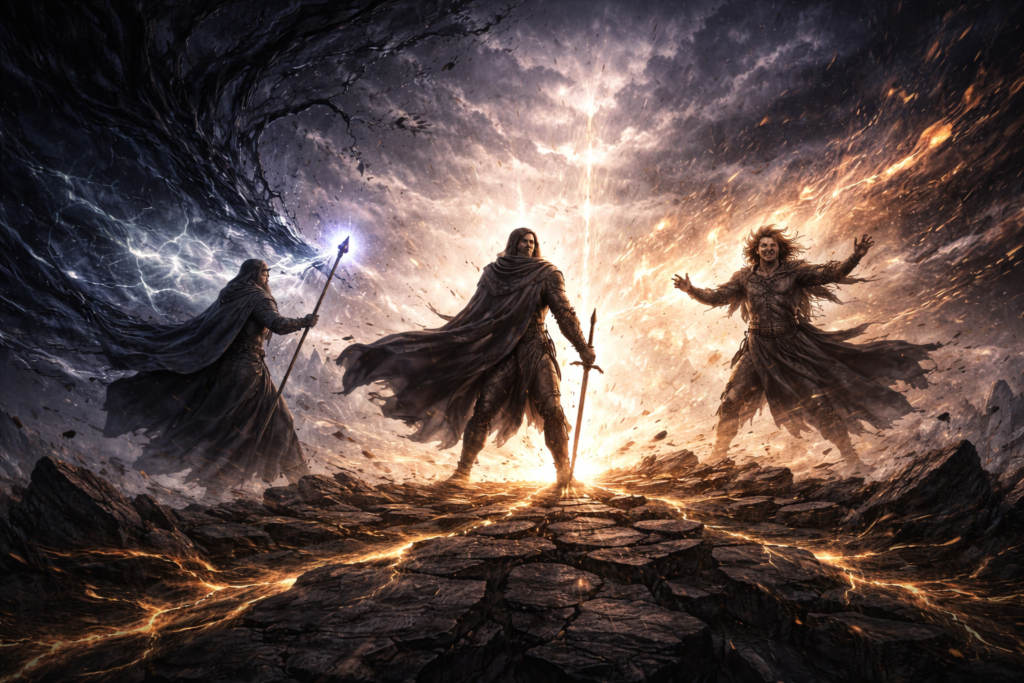
The Six Who Held
They say the world did not fail all at once. It came apart unevenly—laws bending where they should not, borders dissolving into blood and hunger, and the future itself growing unreliable in places.
In that breaking, six moved instead of waiting. Each faced a different fracture of the world. One walked beyond known rules and returned alone. One called the wild to stand rather than conquer. One met terror with laughter and forged what others would later need. One walked storm and shadow with a faithful beast, lifting the lost where no roads remained. One slipped through locked empires, breaking chains without ruling. One stood between crowns and armies, speaking until violence forgot its purpose.
The legends agree on little beyond this: the six did not save the world by winning. They held it long enough for it to stop tearing itself apart. And when they were gone, the world was still standing.
The Four Things That Should Never Meet
Some elders warn that the world was once shaped by great forces given form.
They speak of decay and renewal, control and freedom—pairs that could exist alone, but not together. When they met, the land twisted, cities failed, and balance became something that had to be maintained rather than trusted.
Most versions of the story end before explaining what became of them. Parents tell it anyway, as a reminder that some powers are not meant to agree.
The Place That Isn’t Always There
There is a story about a place where all paths cross—but only sometimes.
Some say it appears as stone. Others say it is a moment, not a location. A few insist they passed through it once without realizing until much later, when their lives refused to settle properly again.
All versions agree on one thing: if you ever think you have found it, you should leave.
The Storm That Knows Your Name
Skyfolk speak of a storm that does not drift.
It waits where routes fail and crossings turn unreliable. Lightning crawls inside it like veins, and the wind sounds almost like breath. Some claim they heard their own name spoken from within the thunder.
Most pilots avoid the places where the storm is said to linger. Those who don’t are rarely eager to tell the story afterward.
The World That Was Folded
Some elders say the world is not shaped the way it looks.
They claim there was a time when the land ran farther, the skies stretched wider, and distance behaved honestly. When something went wrong, the world was folded inward to keep it from tearing itself apart.
In these tellings, far places grew close, familiar routes became strange, and some locations slipped away entirely. Travelers who vanish without explanation are sometimes said to have walked the old edge without realizing it was still there.
People tell this story when maps stop agreeing.
The Thing That Was Locked Outside
There is a quieter story, rarely told above a whisper.
It says the great war was not fought to defeat something, but to keep it out. That whatever threatened the world could not be destroyed—only denied entry. When the fighting ended, the doors were sealed, and the cost of sealing them was everything that came after.
Those who believe this story say the silence of the gods is not absence, but vigilance. And that knowing too clearly what was kept out would weaken the lock.
The People Who Were Not Singular
Some stories speak of people who were never just one thing.
They remembered lives that were not theirs. They survived choices that should have ended them. They walked away from events that killed everyone else involved.
In most tellings, these people do not stay long. They vanish, change beyond recognition, or are forgotten entirely. Folk say the world makes them when it is under too much strain.
The Cities That Didn’t Fall
There are ruins that make sense. Then there are the others.
Cities with no sign of battle. Roads that simply stop. Buildings swallowed gently by earth or time, as if the land grew tired of holding them up. Some insist these places were not destroyed, but forgotten.
Maps rarely agree on where they were.
The Lie That There’s Nothing Left to Find
This story is usually told as a warning.
People say the world has already been explored. That the routes are known, the maps are finished, and anything worth finding has already been claimed. That only fools leave the road.
Treasure hunters tend to laugh at this one. So do ruins.
Deeper Fireside Legends
The Swan Who Held the Grove
They say a corruption reached a sacred place and stopped—not because it was destroyed, but because it was held. Roots closed. Water rose. Life folded inward until the rot could go no farther.
Some say a token was carved from that place, smooth and pale, meant not to command or protect, but to remember. People argue whether the place still exists, or whether it sealed itself away forever.
What everyone agrees on is that the corruption never crossed that line again.
The One Who Stood Where the World Bent
Guards tell of a place where the land itself strained under a weight it was never meant to bear. Many passed by quickly. One stayed.
Stone cracked. Steel bent. The strain did not spread. Whether the one who stood there was rewarded or punished is debated, but veterans usually agree on this much: standing is sometimes its own cost.
The One Who Would Not Fall Quietly
This story is always told with laughter that sounds a little forced.
It speaks of someone who refused to accept the limits everyone else obeyed. When the ground shook and the sky threatened to break, they laughed and pushed back anyway—through craft, cleverness, or sheer refusal.
No one agrees how it ended. The laughter is always the last thing remembered.
No one agrees when they first appeared.
Some say they came after the gods fell silent. Others insist they were always there, simply unnoticed until the world grew afraid. They arrive without announcement—at births that go wrong, at doors where grief has settled too long, at places where hope is thin and no one has sent for help. By the time people think to ask who they are, the work is already done.
They never stay long. A meal may be shared, a song hummed while hands are busy, a quiet word spoken that somehow settles more than it should. Those who try to follow them later find only ordinary cottages, empty roads, or gardens that feel warmer than they ought to. Villages remember them not by faces, but by outcomes: a child who lived, a fever that broke, a night that did not end in mourning.
Some elders claim they are bound together by more than kinship or custom. That they know when one another is needed, no matter the distance. Others scoff and say such stories grow wherever kindness lingers too long. Yet across Pathalis, people leave bread on windowsills for strangers they cannot name—and in the morning, the bread is gone, and the house feels lighter.