


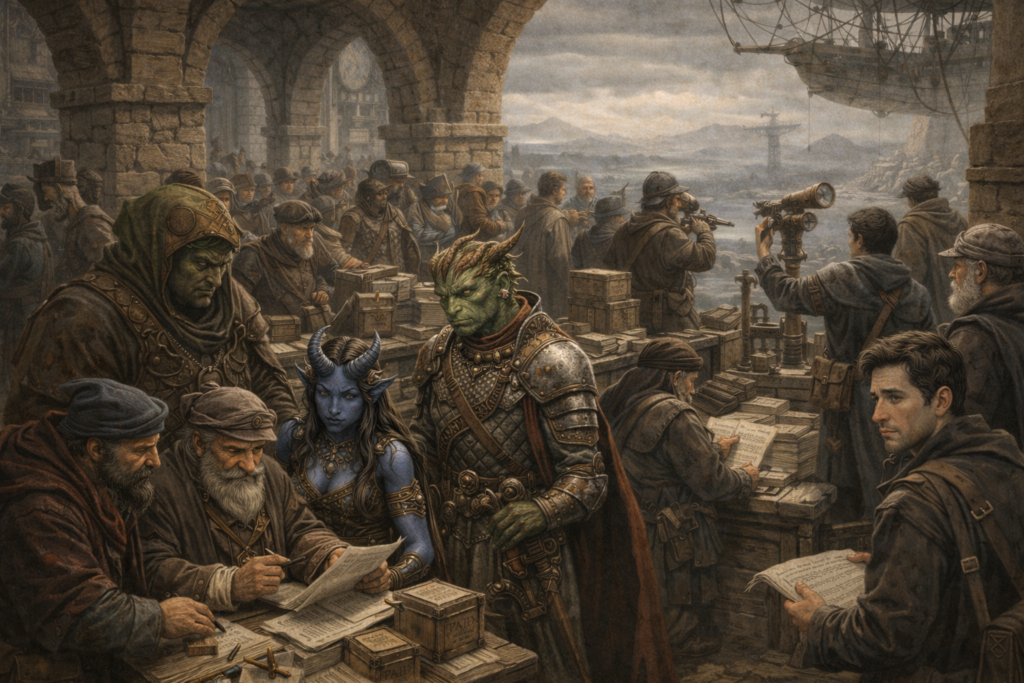
A land of mixed peoples, mixed work
Pathalis is crowded in the places that matter—ports, portal plazas, sky-docks, market streets—and strikingly empty everywhere else. Most folk you meet are shaped less by ancestry and more by trade, route, and reputation: who they travel with, what they carry, and which laws (or customs) they live under.
In the cities, it’s normal to see many different peoples living side by side. Most communities don’t sort strangers into “good” and “evil” by what they are—only by what they do. People learn quickly that a polite face can steal your purse, and a rough one might save your life.
There are beings that most settlements treat as hazards rather than neighbors—things like demons, mindless undead, and other threats that don’t reliably choose restraint. Those are handled as dangers, not as “cultures.”
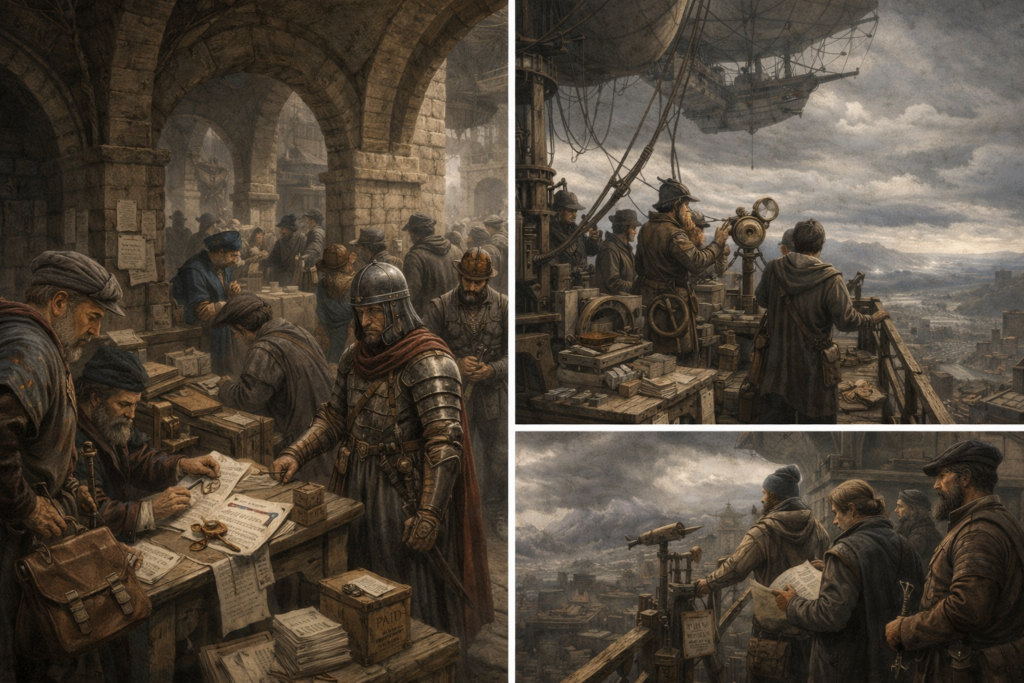
City folk and sky folk
City folk tend to be practical and schedule-minded: laws posted in public, receipts stamped, contracts witnessed, and disputes settled by process (or by whoever has authority). Sky folk—pilots, deckhands, couriers, dock crews—live by weather, aether currents, and the reliability of routes. Their trust is earned in storms, not speeches.
Merchants, guilds, and quiet professionals
Across Pathalis you’ll find:
- Merchants and factors who can quote tolls and rates from memory.
- Craftsfolk trained for high-wear industries: dock repairs, hull patching, rigging, ward upkeep.
- Scribes and contract-magi who turn agreements into enforceable paper.
- Guides and guards-for-hire who make their living in the gaps between portals and small towns.
In many places, information is treated like a commodity—bought, traded, or “paid forward” as favors.
Authority looks different in every place
Some regions are defined by heavy law and visible enforcement; others rely more on local custom, reputation, and community pressure. Either way, most people know where the lines are—because crossing them gets expensive, fast.
People of Pathalis
Pathalis does not elevate people easily.
Fame is regional. Reputation travels faster than truth. Many influential figures are known only by title, nickname, or consequence rather than by name. Entire systems operate without a single widely recognized face.
This is considered normal.
What follows is not a list of the most powerful people in the world—only those whose names or roles persist in record, story, or common conversation.
Scholars, Chroniclers, & Record-Keepers
Aric Talvain
A traveler and observer rather than a ruler, Aric Talvain’s journals circulate widely among scholars, archivists, and adventurers. His writings are valued for what they record—and questioned for what they omit.
Some believe he was simply in the right places at the wrong times. Others suspect intent.
A Note on Names
Pathalis does not preserve identity uniformly.
Fame is local. Authority is institutional. Reputation spreads faster than verification. Many influential figures are known only by title, role, or outcome. Entire systems operate without a single widely recognized face.
This is not considered strange. It is considered practical.
Historical Persons
Pathalis preserves history unevenly. What remains are names recorded at moments when ordinary people were forced into extraordinary circumstances.
These figures are remembered not as rulers, but as witnesses, actors, or anchors during times of upheaval.
Aric Talvain
A traveler, observer, and chronicler whose journals circulate widely among scholars and adventurers. Talvain did not command armies or govern cities. His influence comes from being present and recording events as they unfolded rather than after they were resolved.
His accounts are valued for their detail and restraint—and questioned for what they deliberately leave unresolved.
Orrin of Oakhaven
A schoolteacher remembered for carrying a cursed blade during a period of undead unrest and returning it changed. Orrin refused titles, rewards, or public office and is said to have resumed teaching shortly afterward.
Most references to Orrin appear in academic margins rather than popular histories.
Jarel of Droswade
A printer and pamphleteer associated with reform movements during a period of extreme legal oppression. Jarel is remembered for seizing an artifact of authority and later returning it transformed.
Official records list his disappearance soon after. His writings survive only in partial copies.
Bran of Thalara
A farmer whose name appears in records tied to a widespread ecological crisis. Bran is noted for confronting the source directly and returning with a stabilized remnant.
He rejected honors and insisted on remaining a farmer. Rural communities speak his name with quiet respect.
Seren of Veyrun
A bard active during a period of civic fracture and unrest. Seren is credited with removing a destabilizing musical artifact from circulation and returning it in a restrained form.
Accounts note that its use carried personal cost. Later histories struggle to classify Seren as artist, mediator, or something between.
Hiri the Great
A historical ruler remembered for order, infrastructure, and civic endurance. Opinions on Hiri’s methods vary widely, but few dispute the lasting structural impact of his reign.
His name persists more often in civic terminology than in story.
A Note on Historical Memory
History in Pathalis favors recorded action over legend.
Many acted decisively and were never named. Others are remembered only because someone wrote while events were still unfinished.
This is considered sufficient.
Living Figures
Unlike historical persons, living figures in Pathalis are rarely universal. Their names travel unevenly, shaped by rumor, trade routes, and proximity rather than proclamation.
Influence does not require visibility.
The Broker (No name recorded)
Across Pathalis, the title “the Broker” refers to a figure—or possibly a role—associated with arrangements that exist outside formal authority.
The Broker does not rule territory, command armies, or issue laws. Their influence comes from access: to information, introductions, and solutions that cannot be requested openly.
People who speak of the Broker do so carefully, and never with certainty.
Heidrich Frankenstein (Public Record)
Heidrich Frankenstein was once known as a military scientist and applied arcane researcher, associated with early experimentation in battlefield enhancement, discipline systems, and controlled arcane augmentation.
Among his most controversial pursuits were attempts to crossbreed sentient species, framed at the time as efforts to improve survivability, adaptability, and operational cohesion under extreme conditions. Surviving records describe these projects as theoretically promising but ethically severe, and many were terminated before reaching public demonstration.
While no formal charges were ever made public, several initiatives connected to his work were abruptly discontinued. Frankenstein was later assassinated while in political exile, leaving much of his research incomplete, confiscated, or deliberately buried.
Among historians, his legacy is treated cautiously: significant, controversial, and deliberately underexamined.
Grolga the Hammer
Owner and operator of the Soaring Gryphon, Grolga is widely known along major sky routes. She is remembered for enforcing strict neutrality, maintaining order without spectacle, and keeping a long memory for those who break her rules.
Rumors about her past circulate freely. None are confirmed.
A Note on the Living
In Pathalis, being alive does not guarantee relevance. Being relevant does not guarantee a name.
Most figures of influence are known by function, title, or effect—and that is usually enough.
Town & City Leadership
Authority in Pathalis is more often tied to institutions than individuals. Where names are known, they are listed. Where they are not, the governing structure itself is what matters.
Meshentown
Governing Authority: The Council of Nine
Meshentown is governed collectively. Individual councilors change over time; the institution itself is what citizens recognize as authority.
Hiri
Governing Authority: Wardens & Civic Council
Hiri emphasizes infrastructure, enforcement, and industrial stability over public debate.
The Hiri Civic Council
- Lord Maraven Kerris — Warden of Infrastructure & Order
- Vailen Thorn — Treasurer & External Contracts
- Cyla Reeve — Education & Civic Training
- Gerrin Voss — Culture & Public Morale
- Maelis Vorn — Industry & Labor
- Bren Aules — Law Enforcement & Security
- Mirielle Ashvale — Preservation & Public Memory
- Elan Tareth — Records & Legal Continuity
- Tana Larkspur — Commerce & Guild Mediation
- Harran Dune — Labor Representation
Silverholme
High Councillor: Seraphina Thorne
Silverholme favors centralized leadership supported by advisory councils. Its ruler is expected to embody restraint, continuity, and long-term planning.
Port Azure
Port Master: Kaelen
Port Azure operates as a trade hub rather than a city-state. Authority centers on tariffs, docking rights, and route arbitration.
Newfreeland
Civic Leadership: Open Councils & Assemblies
Authority emerges through committees, popular support, and temporary mandates rather than permanent offices.
Soulsith
Governing Body: The Bell Council
Representatives tied to the city’s six bells oversee different civic functions. Decisions are slow, ceremonial, and deliberate.
Witch’s Hut
Local Authority: Community Elders
There is no formal ruler. Disputes are handled through elder consensus and longstanding custom. Outsiders often underestimate how effective this system is.
Closing Note: This page reflects how people are known, remembered, and spoken of in Pathalis. Not who secretly matters, not who shaped the world behind the curtain, and not who history may later elevate—only what an informed traveler, scholar, or citizen might reasonably know.