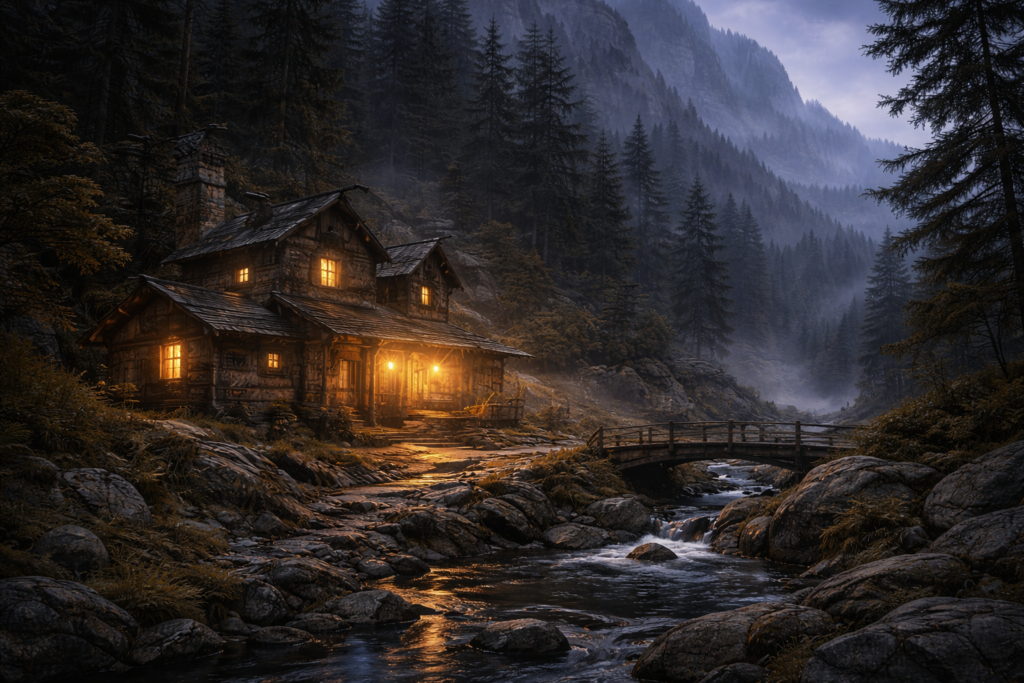



Pathalis is a world defined by where you stand.
Cities do not merely differ in size or wealth; they differ in rhythm, law, belief, and the way the world seems to behave within their borders. Some places are orderly to the point of suffocation. Others thrive on instability. A few feel wrong in ways no map can explain.
This section records known locations—as travelers, residents, and chroniclers understand them.
Not all places are safe.
Not all places agree with each other.
Some places change faster than records can keep up.
Major Cities
The great population centers of Pathalis are hubs of trade, power, scholarship, and conflict. Each exerts influence far beyond its walls through law, economics, or control of vital routes.
City entries typically include:
- General atmosphere and culture
- What visitors immediately notice
- Common laws or customs travelers should know
- Why people come—and why some leave
Towns & Settlements
Smaller communities survive through specialization, location, or stubbornness.
Some are trade stops.
Some exist to support a single industry.
Others persist simply because no one has finished them off yet.
These entries reflect daily life more than power politics.
Sky Taverns & Aerial Waypoints
Pathalis is not bound solely to the ground.
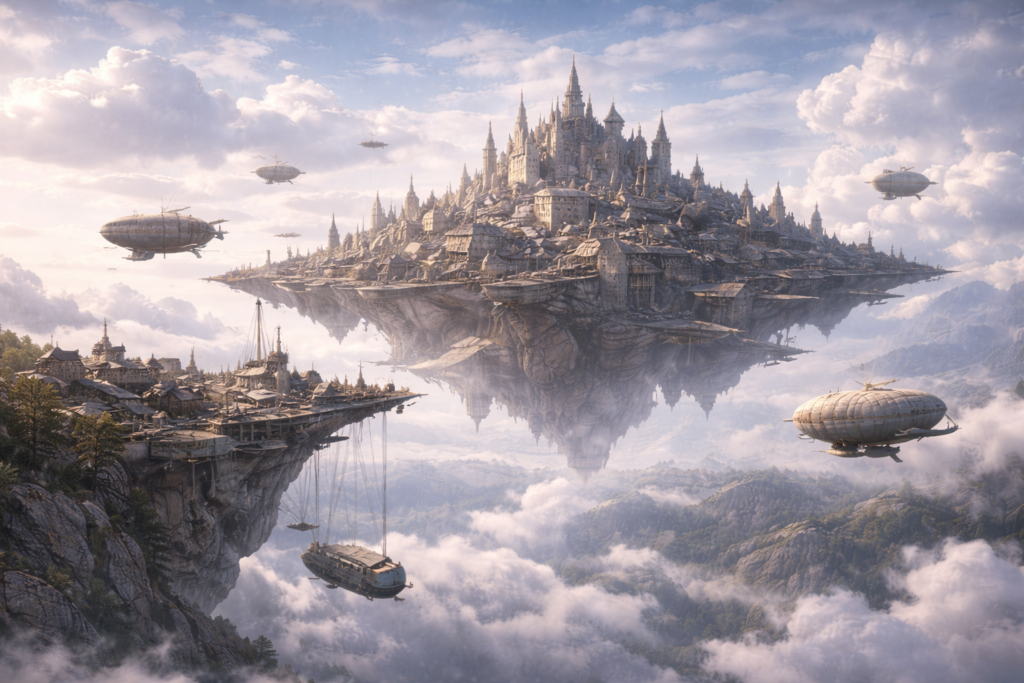
Floating taverns, airborne platforms, and sky-anchored stations act as neutral ground, information exchanges, and vital rest points along the sky-routes. Many travelers will recognize these names long before they ever see them.
Expect:
- Neutral spaces
- Rumors from every direction
- Deals struck over shared tables
- Trouble that arrives without warning
Ruins & Notable Sites
Some places are no longer alive—but they are not gone.
Ruins, abandoned keeps, sealed manors, strange forests, and places that no longer serve their original purpose still shape the world around them. Locals often avoid them. Scholars argue over them. Travelers occasionally regret entering them.
Descriptions here reflect what is commonly believed, not what is proven.
Travel & Distance
Distance in Pathalis is complicated.
Sky-travel has shortened routes, but not removed danger. Weather, traffic, politics, and timing matter as much as miles. Some places are easy to reach but hard to leave. Others are visible for years before a traveler ever sets foot there.
Travel notes focus on expectations, not guarantees.
How to Use This Section
Think of this section as a traveler’s record, not a surveyor’s map.
- Entries may contradict one another
- Details may be incomplete
- Tone reflects reputation as much as reality
If a place feels unfinished, uncertain, or unsettling—
that is intentional.


Cities
Meshentown
Meshentown is not the oldest city in Pathalis, nor the most beautiful.
It is, however, the most consequential.
What happens in Meshentown does not stay in Meshentown. Decisions made here ripple outward through contracts, trade routes, academic doctrine, and enforcement mandates that reshape distant cities long before most people hear the reason why.
Meshentown is a city of systems, and those systems work.
The Shape of the City
Meshentown is vertically layered rather than sprawling.
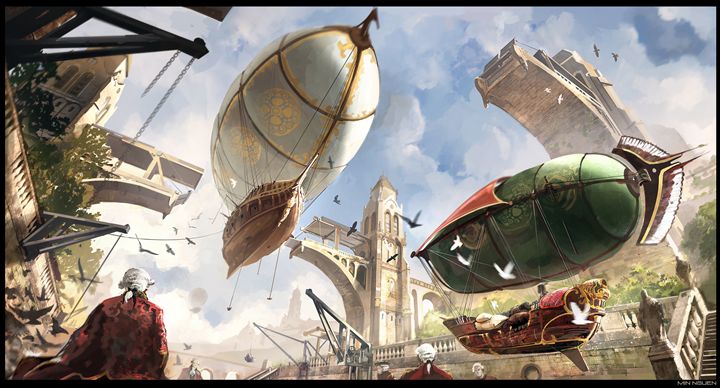
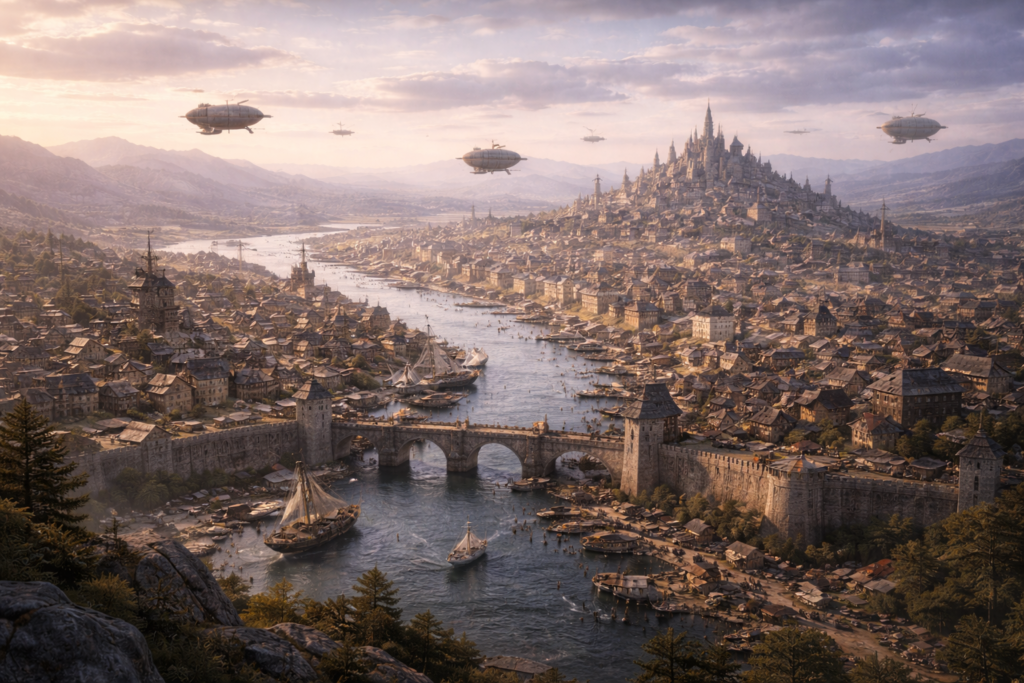
Instead of expanding outward, districts stack, overlap, and interlock through elevated roads, lift-rails, sky docks, and enclosed walkways. From above, the city appears almost engineered—segments of purpose rather than neighborhoods grown by chance.
Broadly, the city can be understood as five overlapping zones:
- Civic & Administrative Core
- University District
- Industrial & Trade Wards
- Residential Tiers
- Aerial Infrastructure
There are no true “slums” in Meshentown—only zones of lesser priority.
Civic Core & Governance
The heart of Meshentown is its civic core: a dense cluster of council halls, legal archives, registries, and enforcement offices.
Governance here is:
- Procedural
- Documented
- Predictable
Edicts are posted publicly. Changes to law are archived and cross-referenced. Ignorance of policy is not treated as innocence.
Citizens rarely speak passionately about the ruling council. Instead, they speak confidently—as if the existence of governance itself is reassurance enough.
Meshentown does not ask whether something is right until it has determined whether it is workable.
Law, Order, and Enforcement
Order in Meshentown is not maintained through fear, but through clarity.
- Rules are visible
- Consequences are consistent
- Enforcement is professional
Guards are present, but rarely aggressive. Their authority comes not from intimidation, but from certainty. When they intervene, it is usually late in a dispute—after all other systems have already failed.
Visitors quickly learn:
- Fighting draws attention
- Contracts matter more than promises
- Paperwork outlives people
The University District
Meshentown’s University is its most famous institution and its greatest export.
The University trains:
- Scholars
- Engineers
- Strategists
- Administrators
- Licensed adventurers
Graduates are known for competence, discipline, and an unsettling comfort with hierarchy. They are taught not just what to do, but how systems respond when things go wrong.
To the public, the University represents:
- Controlled expertise
- Professional problem-solving
- Stability through doctrine
Its libraries are vast. Its rules are strict. Its internal culture is famously insular.
Industry, Trade, and Contracts
Meshentown thrives on regulated commerce.
Major trade houses maintain offices here not because it is convenient, but because legitimacy flows outward from the city. A contract validated in Meshentown carries weight elsewhere.
Key features of Meshentown trade include:
- Standardized measurements
- Enforced contract law
- Arbitration courts
- Certified inspectors
Markets are efficient rather than colorful. Prices are fair, but rarely flexible. Bargaining is seen as a sign of inexperience.
If something can be monetized, Meshentown has already written the framework for it.
Residential Life
Despite its reputation, Meshentown is a lived-in city.
Residential tiers range from modest communal housing to carefully insulated upper residences for officials, scholars, and wealthy contractors. Public services—water, lighting, sanitation—are reliable and closely monitored.
Daily life is structured:
- Work hours are predictable
- Festivals are scheduled well in advance
- Civic announcements are routine
People who thrive here tend to value:
- Stability
- Routine
- Clear expectations
People who do not often leave quietly.
Taverns, Entertainment, and Culture
Meshentown does not lack entertainment—it simply curates it.
- Taverns emphasize quality and safety
- Performances reward skill over chaos
- Public events are permitted, scheduled, and supervised
Spontaneous celebrations are rare. Planned ones are impressive.
Cultural expression exists, but it operates within acceptable bounds. Satire is tolerated. Open defiance is not.
Aerial Infrastructure & Travel
Meshentown is one of the most important sky-ports in Pathalis.
Its airship docks are:
- Heavily regulated
- Precisely scheduled
- Constantly active
Cargo and passengers are processed efficiently. Inspections are routine. Delays are uncommon—but rarely explained.
From Meshentown, one can reach nearly any major region of Pathalis with the right credentials.
Reputation Across the World
Meshentown is described differently depending on who speaks:
- “The backbone of civilization”
- “A city that files people down until they fit”
- “Where wars end before they begin”
- “Where freedom has a processing fee”
What everyone agrees on is this:
Meshentown remembers.
Why People Come — and Leave
People come to Meshentown to:
- Gain recognition
- Secure legitimacy
- Access education
- Influence outcomes without violence
People leave because:
- The city never forgets mistakes
- Systems are slow to forgive
- Some lives resist structure
Meshentown does not chase those who leave.
It simply continues without them.
What Travelers Should Know
- Carry documentation
- Respect posted notices
- Understand that rules apply even when unspoken
- Assume you are being observed, not judged
Meshentown is not hostile to outsiders.
It is indifferent.
▸ Overview
Veridian is a city of perfect intention.
Everything here is aligned toward harmony, efficiency, and collective purpose. Streets are clean. Public spaces are immaculate. Civic pride is visible in banners, uniforms, and synchronized daily routines.
Visitors often describe Veridian as impressive.
Some also describe it as unsettling.
▸ First Impressions
At first glance, Veridian feels calm—almost serene.
Movement is orderly. Conversations are measured. Disputes are rare and resolved quickly. Public announcements occur at regular intervals, and citizens respond to them instinctively.
Nothing appears chaotic.
Nothing appears accidental.
▸ The Shape of the City
Veridian is laid out with near-mathematical precision.
- Broad avenues radiate from civic centers
- Districts are clearly defined by function
- Residential blocks mirror one another in design
- Public buildings dominate sightlines
The city feels planned down to the smallest detail. Even decorative elements seem to serve a purpose.
▸ Governance & Civic Unity
Veridian is governed by an extensive civic bureaucracy that emphasizes unity over individuality.
Decisions are framed as collective necessities. Personal objections are acknowledged—but rarely acted upon. The city prides itself on minimizing conflict through alignment rather than compromise.
Citizens speak often of “the common good,” and mean it sincerely.
▸ Law, Order, & Compliance
Law in Veridian is strict, but rarely violent.
Rules are comprehensive. Expectations are clear. Enforcement focuses on correction rather than punishment—at least at first.
Repeated deviation from civic norms is discouraged strongly, though always “for the benefit of all.”
Visitors may notice that people here do not argue about the rules.
They assume the rules are correct.
▸ Daily Life in Veridian
Life in Veridian is comfortable and predictable.
- Work schedules are synchronized
- Meals are communal more often than private
- Public events occur with clock-like regularity
Citizens appear content. Smiles are common. Laughter is polite.
Spontaneity exists—but within boundaries.
▸ Culture, Art, & Expression
Art in Veridian emphasizes balance, repetition, and clarity.
Murals depict civic achievement. Music favors structure and harmony. Performances celebrate cooperation and shared purpose.
Avant-garde expression is rare and quietly redirected into more “constructive” forms.
▸ Trade & Travel
Veridian engages in trade primarily with cities that value stability and predictability.
Merchants appreciate the reliability of Veridian contracts. Travelers find the city easy to navigate but difficult to truly connect with.
Visitors who stay too long often report a strange sensation:
that the city is slowly teaching them how to behave.
▸ Reputation Across Pathalis
Veridian is described as:
- “A model city”
- “The future of civilization”
- “Peaceful beyond reason”
- “Too perfect to trust”
Those who praise it speak of safety and unity.
Those who criticize it often lower their voices.
▸ Why People Come — and Leave
People come to Veridian to:
- Experience true order
- Escape chaos elsewhere
- Live without uncertainty
People leave because:
- Individuality fades
- Dissent is exhausting
- Silence becomes habitual
Veridian does not stop people from leaving.
It simply does not encourage return.
▸ What Travelers Should Know
(Good candidate for default open)
- Follow posted schedules
- Observe how others behave
- Avoid drawing unnecessary attention
- Remember that cooperation is expected
Veridian welcomes you.
It also expects something in return.
▸ Overview
Ardenbrook is a city that refuses to settle.
Streets shift in purpose, if not in stone. Laws are rewritten, ignored, or reinterpreted depending on who enforces them that week. Innovation thrives here—not because it is encouraged, but because nothing stays stable long enough to stop it.
Ardenbrook survives through momentum.
▸ First Impressions
Visitors often describe Ardenbrook as overwhelming.
Noise carries constantly. Markets bleed into alleyways. Performers, hawkers, inventors, and agitators compete for attention. Arguments erupt and resolve with equal speed.
Nothing feels coordinated—
yet the city does not collapse.
▸ The Shape of the City
Ardenbrook grew outward and inward at the same time.
- Narrow streets open into crowded plazas
- Buildings are repurposed repeatedly
- District boundaries blur and shift
- Temporary structures become permanent through neglect
Maps of Ardenbrook are considered suggestions rather than guides.
▸ Governance & Authority
Officially, Ardenbrook has councils, magistrates, and registries.
Practically, authority is situational.
Power belongs to:
- Whoever controls a street today
- Whoever organizes a crowd
- Whoever can convince others to follow
Edicts are issued frequently and obeyed selectively. Governance here is less about command and more about momentum.
▸ Law, Disorder, & Survival
Law exists, but it is inconsistent.
Some areas enforce rules fiercely. Others ignore them entirely. Disputes are often settled socially before any authority intervenes.
Visitors learn quickly:
- Reputation matters more than paperwork
- Flexibility keeps you alive
- Consistency is rare
Ardenbrook does not punish chaos.
It adapts to it.
▸ Daily Life in Ardenbrook
Life in Ardenbrook is exhausting—and exhilarating.
- Work changes rapidly
- Alliances form and dissolve
- Success favors the bold and the fast
Citizens are resilient, expressive, and fiercely independent. Many thrive here precisely because nowhere else tolerates them.
▸ Culture, Art, & Expression
Ardenbrook is the artistic heart of Pathalis.
Murals appear overnight. Songs change verses mid-performance. Art here is raw, political, emotional, and temporary.
Censorship exists—but only briefly. Something new always replaces what was removed.
If Meshentown records history, Ardenbrook shouts it.
▸ Trade & Travel
Trade in Ardenbrook is risky but lucrative.
Deals are often verbal. Prices fluctuate wildly. Rare items appear without explanation and vanish just as quickly.
Travelers find Ardenbrook difficult to navigate—but impossible to forget.
▸ Reputation Across Pathalis
Ardenbrook is called:
- “A breeding ground for ideas”
- “A riot pretending to be a city”
- “Where revolutions rehearse”
- “Unlivable—and irreplaceable”
People who hate it rarely stay.
People who love it never fully leave.
▸ Why People Come — and Leave
People come to Ardenbrook to:
- Create without permission
- Escape rigid systems
- Disappear into crowds
People leave because:
- Stability never arrives
- Burnout is common
- Chaos eventually demands payment
Ardenbrook does not miss those who leave.
It barely notices.
▸ What Travelers Should Know
(Good candidate for default open)
- Expect plans to change
- Trust people cautiously
- Carry what you need, not what you value
- Follow crowds—but never blindly
Ardenbrook will not protect you.
But it may teach you who you are.
▸ Overview
Girdlewood was once known as the green heart of Pathalis.
It was a city built in deliberate partnership with the forest—stone shaped to accommodate roots, towers grown rather than raised, and streets planned to follow the land’s natural flow. Where other cities imposed themselves, Girdlewood listened, adapted, and endured.
For generations, it stood as proof that civilization and wilderness did not need to be enemies.
▸ First Impressions
Visitors arriving in Girdlewood were often struck by a sense of calm.
Sunlight filtered through layered canopies onto clean stone paths. Birds nested openly in public squares. Water ran clear through carved channels fed by forest springs. The city felt alive—but not untamed.
There was no sense of intrusion.
Only welcome.
▸ The Shape of the City
Girdlewood was designed to grow with its surroundings.
- Broad avenues curved gently around ancient trees
- Buildings were reinforced with living supports
- Elevated walkways wove between canopies
- Public plazas opened beneath natural clearings
Rather than cutting down the forest, the city learned where to step.
▸ Governance & Civic Philosophy
Leadership in Girdlewood emphasized stewardship over control.
Councils included foresters, architects, cultivators, and scholars alongside traditional administrators. Decisions were measured not just in years, but in generations.
Expansion was cautious. Balance was intentional. Growth was permitted only when it did not threaten the long health of the land.
▸ Law, Custom, & Responsibility
Law in Girdlewood was rooted in accountability.
- Environmental harm carried severe penalties
- Certain groves were protected by ancient charter
- Harvesting was regulated and monitored
- Civic duty included maintenance of shared green spaces
The forest was treated not as property, but as a partner whose trust had to be maintained.
▸ Daily Life in Girdlewood
Life in the city followed natural rhythms.
- Work schedules adjusted to seasons
- Markets featured woodcraft, herbs, and living materials
- Communal meals were common
- Children were taught landcraft as readily as letters
Citizens took pride in knowing the names of trees older than the city itself.
▸ Culture, Art, & Belief
Girdlewood’s culture celebrated continuity.
Art emphasized growth, memory, and patience. Music echoed softly through leaves and stone. Festivals marked solstices, planting seasons, and harvests rather than political anniversaries.
Stories focused on preservation—not conquest.
▸ Trade & Travel
Girdlewood was a respected trade partner.
Exports included:
- Masterwork woodcraft
- Rare forest-grown materials
- Living architectural techniques
- Botanical knowledge
Trade routes were carefully maintained, and visitors were expected to respect local customs or leave.
▸ Reputation Across Pathalis
At its height, Girdlewood was known as:
- “The city that learned when not to build”
- “Proof that balance is possible”
- “A place where time feels slower”
- “The forest’s favored child”
Other cities admired it—even if few tried to emulate it.
▸ Why People Came — and Stayed
People came to Girdlewood to:
- Learn sustainable craft
- Study living architecture
- Raise families in relative peace
- Escape relentless expansion elsewhere
People stayed because:
- Life felt rooted
- The city endured without rushing
- The land seemed to remember kindness
Girdlewood was not ambitious.
It was patient.
▸ What Travelers Should Know
(Good candidate for default open)
- Respect living structures
- Follow marked paths
- Never harvest without permission
- Understand that permanence here was earned, not assumed
In Girdlewood, progress was measured by how little harm it caused.
▸ Overview
Newfreeland was founded on hope—and on refusal.
It was built by those who chose to step outside older systems of authority: merchants unwilling to submit to entrenched guilds, scholars frustrated by institutional gatekeeping, refugees and idealists seeking a place unburdened by inherited power.
Newfreeland did not reject governance outright.
It rejected external control.
What it lacked in backing and resources, it attempted to replace with conviction.
▸ First Impressions
Visitors arriving in Newfreeland often mistook activity for prosperity.
The harbor was busy. Streets were loud and crowded. Construction was constant—repairs layered over older repairs, new districts rising before older ones were finished. Conversation was open, familiar, and unguarded.
Newfreeland felt young.
And youth, at a distance, looked like confidence.
▸ The Shape of the City
Newfreeland grew outward with optimism—and without restraint.
- Wide streets intended for future expansion
- Districts named for ideals rather than families or functions
- Public squares meant for gathering rather than oversight
- Architecture designed to be adaptable, not enduring
The city planned for a future it assumed would arrive quickly.
In some places, it did.
In others, it never came.
▸ Governance & Civic Spirit
Governance in Newfreeland emphasized participation and access.
Councils were open. Debate was encouraged. Laws were revised frequently in response to changing needs. In theory, every voice mattered.
In practice, time, influence, and survival shaped who could afford to be heard.
Those with resources spoke often.
Those without learned to speak carefully—or not at all.
▸ Law, Justice, & Trust
Newfreeland relied heavily on community trust to maintain order.
Formal enforcement existed, but it was thinly stretched. Many disputes were handled locally, through mediation or reputation rather than courts.
This worked—until scarcity set in.
As food shortages grew and trade fluctuated, theft became common. Informal power structures emerged. Those able to protect resources accumulated more of them, while others found themselves increasingly excluded.
The city believed most people wanted to do right.
It had fewer answers for what happened when doing right became unaffordable.
▸ Daily Life in Newfreeland
Life in Newfreeland was energetic—and uneven.
- Markets favored local trade, but supply was inconsistent
- Taverns served as meeting halls, hiring spaces, and rumor exchanges
- Festivals celebrated founding ideals more than current conditions
- New construction continued even as older districts decayed
Neighbors knew one another, but knowledge did not always translate into security. Children grew up hearing stories of the city’s founding while watching adults worry about the next winter.
▸ Culture, Art, & Expression
Newfreeland’s culture was relentlessly forward-looking.
Art celebrated possibility. Music favored lively tunes that ignored hardship rather than confronted it. Stories emphasized second chances, chosen family, and the belief that tomorrow would correct today.
For some, this was inspiring.
For others, it was exhausting.
Tradition was not preserved—because there had not yet been time to decide what deserved preserving.
▸ Trade & Travel
Newfreeland aspired to be a major trade hub.
Its port welcomed independent merchants and experimental ventures, but without the leverage or protection enjoyed by older cities. Deals were fair—until they weren’t. Reliability depended heavily on who was negotiating.
Airship traffic increased for a time, then fluctuated as confidence wavered.
Travelers often stayed longer than planned.
Some because they believed in the city.
Others because leaving was harder than expected.
▸ Reputation Across Pathalis
Newfreeland was known as:
- “The city that chose itself”
- “Too free to survive, or too young to know better”
- “A place where ideals outpaced resources”
- “A gamble worth taking—once”
Established cities watched it carefully.
Some with hope.
Others with quiet certainty.
▸ Why People Came — and Stayed
People came to Newfreeland to:
- Start over
- Escape entrenched hierarchies
- Build something new
- Live by choice rather than inheritance
People stayed because:
- Leaving meant admitting failure
- Community still mattered
- Power structures, once formed, were hard to escape
Newfreeland did not promise safety.
It promised freedom—and discovered the cost of it.
▸ What Travelers Should Know
- Expect rapid change
- Reputation spreads quickly—and unevenly
- Resources are not distributed equally
- Ideals matter, but leverage matters more
In Newfreeland, the future was never guaranteed.
It was contested.
▸ Overview
Hiri—often called “The Great Hiri”—is a city built on the belief that progress is a civic responsibility.
Located in southern Pathalis, Hiri is known for balancing commerce, engineering, art, and law without allowing any single force to dominate. It is widely regarded as a model city: efficient without being cold, ordered without being oppressive.
Where other cities struggle between ideals and practicality, Hiri insists they can coexist.
▸ First Impressions
Visitors often describe Hiri as clean, bright, and alive with motion.
Arcane trams hum between marble towers and glass bridges. Music drifts from open plazas. Lanterns glow evenly at night, and public spaces feel intentionally designed rather than inherited.
The city feels confident—not loud, but assured.
▸ The Shape of the City
Hiri is organized in clear, purposeful districts:
- Highspire Ward — Government, academies, and civic institutions
- Forge Quarter — Industry, engineering, and fabrication yards
- Merchant Ring — Markets, inns, auctions, and trade halls
- Old Canal District — Artists, students, converted warehouses, nightlife
- Portal Ring — Regulated portal infrastructure and transit oversight
- River Walk — Lantern-lit promenades, music, and evening gatherings
The city is compact, navigable, and deliberately planned for growth without sprawl.
▸ Governance & Civic Order
Hiri is governed by a City Assembly of Twelve, chaired by the Warden of Hiri.
Representation comes from guilds, educators, labor interests, civic services, and commerce. Decisions require cooperation rather than dominance, reinforcing compromise as a governing principle.
Law enforcement is visible, professional, and restrained. Justice emphasizes consistency and transparency, and contracts—once entered—are binding for all parties.
Hiri’s motto, engraved above its Assembly Hall, reads:
“Order in Purpose.”
▸ Trade, Industry, & Innovation
Hiri is a major center for:
- Aether fabrication
- Engineering and infrastructure design
- Artistry and diplomatic training
- Caravan and portal-adjacent trade
Industry and art are treated as equal contributors to civic identity. Magic here is practical and public—used for lighting, transit, sanitation, and sound rather than spectacle.
Commerce is encouraged, but openly regulated. Profit is respected; control is not surrendered.
▸ Daily Life in Hiri
Life in Hiri is structured but humane.
Public transit runs on predictable schedules. Markets are orderly and fair. Education is visible and valued. Festivals and civic events are common and well attended.
Residents take pride in the city’s function. Visitors notice that things work—and that people expect them to.
▸ Culture, Art, & Expression
Hiri believes that culture is infrastructure.
Music, performance, and public art are woven into daily life rather than isolated as entertainment. Bardic traditions are respected as tools of diplomacy and civic cohesion.
Festivals emphasize shared achievement rather than conquest. Art celebrates precision, cooperation, and invention.
▸ Travel & Reputation
Hiri is considered one of the safest and most reliable cities to visit in Pathalis.
Its inns are reputable, its markets regulated, and its transit predictable. Travelers often describe it as a place where agreements mean something.
Across the realm, Hiri is known as:
- “The city that made progress respectable”
- “Where commerce and conscience share a table”
- “The place where systems actually work”
▸ What Travelers Should Know
(Good candidate for default open)
- Order is valued and enforced
- Contracts matter
- Innovation is respected, but recklessness is not
- The city rewards preparation and honesty
In Hiri, success is rarely accidental.
▸ A Local Saying
“Every sound has a place.
Every place has its rhythm.”
▸ Overview
Silverholme is a city defined by endurance and precision.
Set against harsh terrain and difficult access routes, Silverholme grew around extraction, refinement, and disciplined craft. It is not expansive, but it is dense with expertise. The city values durability—of materials, systems, and agreements.
Silverholme does not promise comfort.
It promises reliability.
▸ First Impressions
Visitors often notice the quiet first.
The streets are orderly, the air sharp, and movement deliberate. Buildings are stone-heavy and functional, reinforced against weather and time. Little is decorative without purpose.
The city feels older than it is—by intent.
▸ The Shape of the City
Silverholme is compact and vertical.
- Reinforced stone districts built into natural elevation
- Central refining and storage complexes
- Secure trade halls rather than open markets
- Clearly defined residential and industrial separation
Expansion is measured. Nothing is built without a plan to maintain it.
▸ Governance & Civic Order
Governance in Silverholme emphasizes accountability.
Authority is granted through proven competence rather than popularity. Civic roles are long-term and difficult to obtain, but stable once held. Laws change slowly, after extended review.
Disputes are resolved through documented process rather than public debate.
▸ Trade, Craft, & Industry
Silverholme is known for:
- Refined metals and precision components
- Durable construction materials
- Contract manufacturing and long-term supply agreements
Trade favors consistency over speed. Buyers come to Silverholme when failure is unacceptable.
▸ Daily Life in Silverholme
Life is disciplined and predictable.
Workdays are long. Social spaces are reserved. Community forms through shared labor rather than celebration. Residents tend to be reserved but dependable.
Visitors who expect warmth often leave quickly.
Those who value structure tend to return.
▸ Reputation Across Pathalis
Silverholme is known as:
- “The city that does not rush”
- “Where promises are heavier than words”
- “Cold—but dependable”
▸ What Travelers Should Know
- Contracts are enforced strictly
- Informality is viewed as carelessness
- Quality is expected, not praised
In Silverholme, trust is earned slowly—and kept carefully.
▸ Overview
Port Azure is a city of movement and exchange.
Built around sea and sky access, it serves as a major point of transition between regions, cultures, and economies. Goods arrive constantly. People rarely stay long.
Port Azure thrives on flow.
▸ First Impressions
Port Azure is loud, colorful, and crowded.
The harbor is always active. Docks overlap with markets. Airship moorings sit beside sea piers. Languages mix freely, and negotiations spill into public spaces.
The city feels alive—and never finished.
▸ The Shape of the City
Port Azure spreads outward along the coast and upward into layered terraces.
- Dock districts with mixed use housing
- Market quarters that shift daily
- Sky mooring platforms integrated into older structures
- Entertainment and lodging clustered near transit
Change is constant. Districts redefine themselves regularly.
▸ Governance & Civic Balance
Governance in Port Azure is flexible by necessity.
Authority exists, but enforcement prioritizes keeping trade moving over rigid order. Laws emphasize mediation and restitution rather than punishment, especially in commercial disputes.
Control comes through influence and coordination rather than force.
▸ Trade, Travel, & Exchange
Port Azure handles:
- High-volume trade
- Short-term contracts
- Cultural exchange and transport services
Deals are quick. Relationships are temporary. Reputation matters—but only as long as it remains useful.
▸ Daily Life in Port Azure
Life is fast and opportunistic.
Residents adapt quickly or move on. Work changes often. Social circles are fluid. Entertainment thrives because tomorrow is never guaranteed.
Stability is optional. Awareness is not.
▸ Reputation Across Pathalis
Port Azure is known as:
- “The city where everything passes through”
- “Profitable, unpredictable, and necessary”
- “Easy to enter—hard to truly know”
▸ What Travelers Should Know
- Watch your agreements
- Verify your contacts
- Expect change
In Port Azure, motion is safety.
Overview
Greyfang is a city shaped by proximity to danger.
Situated near unstable regions and contested routes, it exists because it must. Greyfang is not polished, but it is prepared. Survival, not growth, defines its priorities.
▸ First Impressions
Greyfang feels tense.
Walls are reinforced. Patrols are visible. Buildings show signs of repeated repair. The city is alert without being chaotic.
Nothing here is accidental.
▸ The Shape of the City
Greyfang is built defensively.
- Fortified outer districts
- Central command and supply zones
- Narrow streets designed for control
- Minimal decorative architecture
Everything serves a function.
▸ Governance & Security
Governance in Greyfang prioritizes order and response.
Authority is centralized. Decisions are made quickly. Enforcement is strict but predictable. Citizens understand the rules because ambiguity is dangerous.
▸ Trade & Necessity
Trade in Greyfang is practical.
Supplies, weapons, repair materials, and transport services dominate. Luxury is rare. Reliability is prized.
Merchants who operate here know exactly why they are present.
▸ Daily Life in Greyfang
Life is cautious and communal.
People rely on one another. Outsiders are watched closely. Trust forms through shared risk rather than friendliness.
Those who stay long enough learn the city’s rhythm.
▸ Reputation Across Pathalis
Greyfang is known as:
- “The city that stands”
- “Unwelcoming—but honest”
- “Where danger is expected, not feared”
▸ What Travelers Should Know
- Follow instructions
- Keep your purpose clear
- Do not test boundaries
In Greyfang, survival is a civic value.
Overview
Melbrooksia is remembered not as a place that endures, but as a people who persist.
Its name survives primarily through song, march, and shared memory rather than through standing walls or recognized borders.
Geography (As Remembered)
Accounts consistently associate Melbrooksia with a harsh borderland where environments meet:
- Sun-scoured sands
- Grasslands at their edge
- A nearby coast shaped by salt wind and surf
This places Melbrooksia in a liminal region—neither wholly inland nor securely coastal.
Cultural Identity
Melbrooksia is defined by movement and cohesion rather than settlement.
Songs and oral tradition describe disciplined columns, raised banners, and the steady sound of pipes used to keep formation and morale. Identity is maintained through ritualized marching, shared oaths, and collective memory.
Melbrooksia was not merely civilian in character. Its people were accustomed to organization and armed travel.
Historical Fate
Melbrooksia’s homeland no longer stands.
Its walls are described as destroyed, its borders collapsed, and its people displaced by war. The loss was violent rather than gradual, and the survivors are remembered as refugees rather than migrants.
The cause is framed as conflict and political failure, not natural disaster.
Legacy
Though Melbrooksia as a place is gone, its name persists in martial songs and refugee lineages.
It is remembered less for where it stood, and more for how its people moved after it fell.
▸ Overview
Witch’s Hut is a small but remarkably well-known settlement built above the mist-choked swamplands.
Rather than fight the marsh, the town rises over it—constructed on an elevated network of enchanted cobblestones that keep streets dry, safe, and gently illuminated after dusk. What began as a practical solution became the settlement’s defining feature.
Witch’s Hut is not large, but it is deliberate, welcoming, and unusually comfortable for a place so far from major cities.
▸ First Impressions
Visitors arrive through toll houses that mark the entrance to the raised pathways.
Lanternlight reflects off wet reeds below. Music and conversation drift through the fog. The air smells of cooked food, herbs, and warm stone rather than stagnant water.
The settlement feels protected—both physically and socially.
▸ The Shape of the Settlement
Witch’s Hut is compact and walkable.
- Raised cobblestone streets hover above the swamp
- Buildings cluster closely, with residences above shops
- Most destinations are only a few minutes apart
- Subtle guiding runes help visitors navigate
The town favors density over sprawl, creating a sense of closeness and shared space.
▸ Governance & Local Order
Witch’s Hut operates through custom, cooperation, and reputation rather than heavy enforcement.
Local wardens maintain safety on the walkways, but most order is upheld socially. Disruptive behavior is discouraged quickly—not through force, but through exclusion.
The settlement values harmony over authority.
▸ Trade, Hospitality, & Services
Despite its size, Witch’s Hut supports a surprising range of services:
- Multiple restaurants and food stalls
- Specialty shops and traveling merchants
- An apothecary known for reliability and discretion
- Magical messaging and portal-adjacent services
At the center of the settlement stands The Witch’s Bane, a renowned inn and resort that serves as the town’s primary hub for visitors.
▸ Daily Life in Witch’s Hut
Life in Witch’s Hut is communal and steady.
Residents know one another. Shops open on predictable schedules. Evenings bring music, shared meals, and soft lantern glow along the paths.
The swamp is ever-present—but rarely felt as a threat.
▸ Culture, Leisure, & Visitors
Witch’s Hut is accustomed to outsiders.
Travelers, performers, and adventurers pass through constantly, drawn by comfort, entertainment, and the settlement’s reputation as a safe stopping point.
Festivals, performances, and casual games are common, especially near The Witch’s Bane and nearby venues.
▸ Reputation Across Pathalis
Witch’s Hut is known as:
- “The lantern town above the swamp”
- “A place where the road pauses”
- “Strangely safe, given where it is”
- “Hard to leave once you stop”
Many visitors intend to stay a single night—and remain far longer.
▸ What Travelers Should Know
(Good candidate for default open)
- Stay on the raised paths
- Respect the quiet rules of the town
- Ask before wandering off-route
- Lanterns are not decoration—they matter
In Witch’s Hut, comfort is intentional.
Avenfold
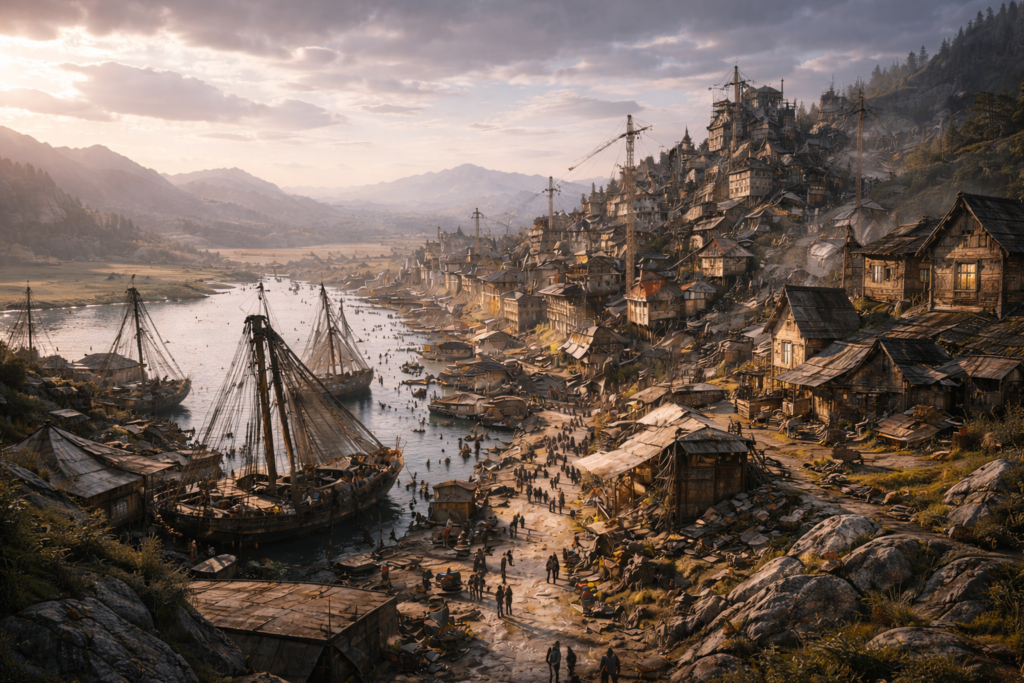
Avenfold is a modest hill settlement positioned along a well-traveled inland route. Its buildings are tightly clustered against the terrain, offering shelter from wind and weather rather than comfort or grandeur.
Travelers regard Avenfold as reliable rather than welcoming. Supplies are available, directions are accurate, and little else is offered without cause.
—
Mirehaven
Mirehaven stands at the edge of low marshland, supported by raised walkways and water-resistant construction. Life here revolves around tides, weather, and long familiarity with unstable ground.
Those who live in Mirehaven are known for patience and caution. Visitors are advised to follow local guidance closely, as the land itself is less forgiving than its people.
—
Briarthorn
Briarthorn is a frontier settlement shaped as much by defense as by necessity. Thorn-lined barriers and reinforced structures give the town its name and its reputation.
It serves as a waypoint for those pushing into less settled regions. Briarthorn offers safety, but not comfort, and expects visitors to respect its boundaries.
—
Coldmere
Coldmere lies in a region where cold and isolation define daily life. Structures are built low and dense, designed to conserve heat and withstand long seasons of poor weather.
The settlement is quiet, deliberate, and inward-focused. Outsiders are not unwelcome, but are rarely indulged.
—
Lir’s Crossing
Lir’s Crossing grew around a critical river passage that links multiple trade routes. Ferries and barges operate regularly, making the crossing a natural point of exchange and gathering.
The town itself is transient in character—many pass through, fewer stay. Information travels quickly here, though it is rarely free.
—
Thornbridge
Thornbridge is built around a reinforced bridge spanning a narrow but dangerous gap. Control of the crossing gives the settlement strategic importance far beyond its size.
The town maintains strict rules regarding passage and trade. Those rules are enforced consistently and without ceremony.
—
Velora’s Gate
Velora’s Gate marks a transition point between regions with differing customs and authority. Gates, watch posts, and administrative buildings dominate the settlement’s layout.
Travelers expect scrutiny here, not hostility. The Gate exists to observe, record, and regulate movement rather than stop it outright.
—
Hearthcairn
Hearthcairn is a stone-built settlement nestled among highland terrain. Communal hearths and shared spaces form the center of social life, particularly during harsh weather.
The town is known for hospitality tempered by tradition. Guests are welcome, but expected to contribute where able.
—
Dewfall
Dewfall sits along a fertile river valley where mist and moisture shape the land. Agriculture and water management define the town’s economy and daily rhythms.
Life in Dewfall is steady and cyclical. It is often described as unremarkable—by those who have never needed it.
—
Amberfen
Amberfen is built atop hardened wetlands rich in resinous deposits. Structures incorporate treated wood and amber-hued materials harvested locally.
The settlement is known for trade in preserved goods and durable materials. Movement through the surrounding fen is difficult without local knowledge.
Aetherhaven
Aetherhaven is a floating industrial settlement built around sky-mining operations. Platforms, gantries, and reinforced docks surround a dense central hub where crews rotate in and out on strict schedules. The air hums with machinery and controlled magic.
Life here is work-focused and temporary by design. Most residents arrive on contract and leave when it ends. Those who stay longer tend to become part of the infrastructure itself—quiet experts who keep the haven running.
—
Sky-Gem Outpost
Sky-Gem Outpost is a small but heavily guarded platform established to extract rare crystalline resources from high-altitude formations. Access is controlled, and visitors are questioned thoroughly before being allowed to dock.
The outpost is known for long hours, tight security, and sudden wealth. Stories circulate of fortunes made quickly—and lost just as fast—by those who misjudge the risks of working so high above the world.
—
Cloud-Whisper Outpost
Cloud-Whisper Outpost drifts far from major routes, its purpose only loosely explained to most travelers. From the outside it appears quiet, even abandoned, but it maintains active docks and a minimal permanent staff.
Pilots report that weather behaves strangely nearby, and conversations tend to lower in volume upon arrival. Those who dock here rarely stay long, but almost everyone leaves with the sense that they were noticed.
—
Skybreaker MountainsThe Skybreaker Mountains rise into the upper reaches of the sky, their peaks cutting through cloud layers and disrupting air-currents. They are both a navigational hazard and a landmark used by experienced pilots.
Legends speak of hidden routes, abandoned stations, and weather that behaves with intention. Most airships keep their distance unless necessity—or curiosity—demands otherwise.
Soulsith (The Town of Six Bells)
Soulsith is a quiet, deliberate town where time is measured as carefully as words. Six great bells govern daily life, each marking a transition rather than an hour—work, rest, gathering, silence, reflection, and sleep. Outsiders often find the rhythm unsettling at first, but long-term residents insist it brings clarity and balance to life.
The town values ritual, restraint, and memory. Visitors are welcomed, but expected to listen more than they speak. Soulsith is known throughout Pathalis as a place where people go to slow down, recover, or decide what comes next.
—
Riverbend
Riverbend is a practical trade town built around a wide, unpredictable river. Barges, ferries, and seasonal markets define its economy, and most residents are accustomed to rebuilding after floods rather than preventing them entirely. Life here rewards adaptability and local knowledge.
The town serves as a common stopover for merchants and travelers moving inland. Riverbend is not wealthy, but it is resilient, and its people are known for directness and quiet hospitality.
—
Ironstrike
Ironstrike grew around forges, quarries, and hard labor. The town’s economy revolves around metalwork, stonecutting, and heavy transport, and nearly every family has ties to a trade guild or craft hall. Smoke and hammer-ring are constant features of daily life.
Though rough in appearance, Ironstrike is orderly and dependable. Contracts are honored, work is respected, and outsiders who pull their weight are treated fairly.
—
Sunstone
Sunstone is a small settlement known for its bright stonework and open plazas. Buildings are constructed to catch and reflect light, giving the town a warm appearance even in poor weather. Artisans, stonemasons, and traders favor Sunstone for its calm pace and reliable routes.
The town is often described as optimistic—sometimes overly so—but it remains a favored place for families and travelers seeking rest rather than opportunity.
—
Whispering Pines
Whispering Pines sits at the edge of a dense forest, its buildings spaced deliberately to preserve quiet and visibility. Wind through the trees carries sound in strange ways, and locals are adept at communicating subtly over long distances.
The town is cautious but not unfriendly. Residents value privacy, vigilance, and mutual protection, and visitors are advised to respect local boundaries and customs.
—
Whisperwood Grove
Whisperwood Grove is less a town and more a clustered community built around a protected stand of ancient trees. Permanent structures are few, and many dwellings are semi-temporary or grown rather than built.
The Grove is known as a place of retreat, learning, and quiet exchange. Those who arrive seeking peace are usually welcome; those who arrive seeking control are not.
—
Windmere
Windmere is a small coastal village shaped more by geography than by history. Pressed between steep mountains on one side and a sheltered bay on the other, it sits apart from major routes and wider concerns.
It is a place most people pass around rather than through.
Blackwater Port
Blackwater Port is a weather-beaten coastal settlement that survives through fishing, salvage, and opportunistic trade. Fog, tides, and rough waters make approach difficult, but experienced sailors value the port for its discretion and lack of questions.
The town has a reputation for minding its own business. Deals made in Blackwater are rarely spoken of afterward
The Turning Lantern
The Turning Lantern is a well-known roadside inn positioned at a junction where routes diverge. Its lanterns are rotated nightly to signal weather and road conditions.
Travelers rely on it as much for information as for rest.
—
The Iron Chalice
The Iron Chalice is a heavily reinforced inn catering to merchants and guards. Its construction prioritizes security over comfort, and disputes are handled swiftly.
It is favored by those transporting valuable or sensitive cargo.
—
The Drunk Saint
The Drunk Saint is a loud, crowded tavern known for uneven quality and consistent rumors. Stories exchanged here are rarely reliable, but often useful.
Those who listen carefully tend to leave better informed than those who speak.
—
The Candle’s Echo
The Candle’s Echo serves as a quiet waystation along a less-traveled route. Its name comes from the practice of leaving a single candle burning overnight for late arrivals.
It is valued for discretion and solitude rather than entertainment.
The Soaring Gryphon
The Soaring Gryphon is a drifting sky tavern known across Pathalis as neutral ground. Anchoring along major air-routes, it serves merchants, adventurers, couriers, and travelers who need food, news, or a place to wait out bad weather. Its schedule changes, but its reputation does not.
Inside, deals are made quietly and arguments are discouraged. Those who cause trouble are remembered—and not welcomed back. Many consider the Gryphon the safest place in the sky to hear what the world is whispering.
The Witch’s Bane
The Witch’s Bane is a renowned inn and leisure resort located at the heart of the Witch’s Hut settlement. Built for comfort rather than speed, it caters to travelers who intend to stop—not merely pass through.
Known for its warm hospitality, tiered accommodations, and constant entertainment, the Witch’s Bane serves merchants, adventurers, performers, and dignitaries alike. Business is conducted openly, disputes are discouraged, and guests who disrupt the peace quickly find themselves unwelcome.
Many arrive seeking rest.
Most leave with stories—and plans to return.