



The The University is one of the most respected institutions in Pathalis.
It is not a school in the traditional sense, nor is it a military academy. The University exists to train individuals and small teams capable of resolving problems that lie beyond the reach of ordinary law, local guards, or standing forces.
To most citizens, the University represents competence, neutrality, and restraint—an institution designed to prevent crises from becoming wars.
Purpose and Role
The University exists to serve stability.
Cities, guilds, and governing bodies turn to the University when faced with problems that are too dangerous, politically sensitive, or complex for conventional solutions. Rather than deploying armies or escalating conflict, they contract trained operatives capable of acting decisively and proportionally.
The University does not rule, govern, or enforce law on its own authority. Its influence comes from trust: trust that its graduates are capable, disciplined, and bound by contract.

Cadres
The University trains cadres—small, specialized teams formed to address specific types of challenges.
Cadres are assembled for versatility rather than size. Each member brings distinct strengths, allowing the group to adapt to unpredictable situations. Cadres are expected to operate independently, make judgment calls in the field, and resolve matters with minimal collateral impact.
To the public, cadres are known for three things:
- They arrive quietly
- They act decisively
- They leave once the problem is resolved
Their work is rarely celebrated, but frequently relied upon.
Contracts and Oversight
University operations are governed by formal contracts.
When a cadre is deployed, its authority comes from the agreement that empowered it. This ensures accountability while allowing flexibility across jurisdictions. Cadres are answerable both to the terms of their contract and to broader legal frameworks established by local and continental authorities.
The University maintains internal standards of conduct and performance. Cadres that fail to meet these standards do not continue to operate under its banner.
Reputation
Across Pathalis, the University is regarded with a mixture of respect and caution.
Supporters see it as a stabilizing force—one that prevents conflicts from escalating and resolves dangerous situations without spectacle. Critics argue that it concentrates too much power in too few hands, or that its neutrality shields it from scrutiny.
Despite these concerns, demand for University-trained cadres remains high. Few institutions can match its record of successful intervention without open war.
Who Attends
Admission to the University is competitive and selective.
Students come from many backgrounds: scholars, soldiers, specialists, and individuals with uncommon talents. What matters is not origin, but capability and discipline. Training emphasizes cooperation, judgment, and adaptability over raw force.
Graduates do not receive noble titles or permanent authority. What they gain is reputation—and the opportunity to be trusted with responsibility others cannot bear.
Presence in the World
The University maintains facilities in major population centers and regions of strategic importance. Its buildings are typically secure, understated, and functional rather than grand.
While the University does not advertise its internal workings, its presence is unmistakable. When a cadre operates openly under contract, it does so with the University’s authority clearly recognized.
How the Public Sees the University
To most people, the University is neither heroic nor sinister.
It is a tool—one that exists because the world is complicated, and because not every problem can be solved by law, force, or negotiation alone.
When the University becomes involved, something has gone wrong.
When it leaves, the hope is that nothing else will.
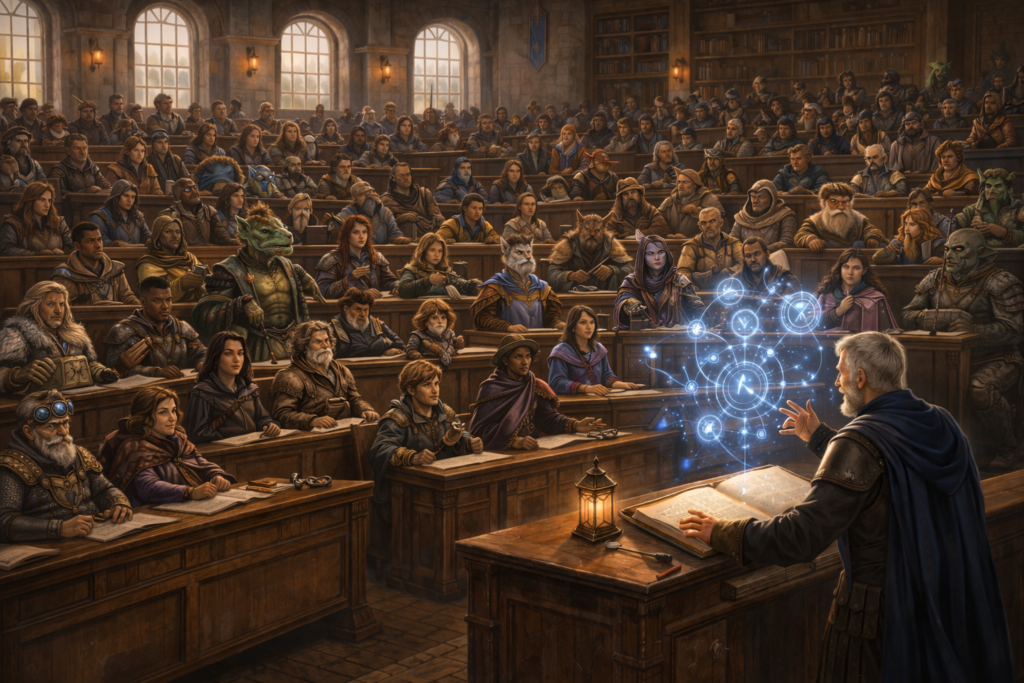
Life at the University is demanding, structured, and deliberately communal.
From the earliest stages of enrollment, students are not trained in isolation. Instead, they are assigned to a cadre group—a small cohort selected to balance temperament, skill, and potential rather than similarity. Once assigned, that group trains, studies, and is evaluated together.
This assignment is not random. The University’s philosophy holds that no individual, no matter how capable, is sufficient on their own. Cadres are built to function as complete units, capable of adapting to unpredictable situations through cooperation rather than specialization alone.
Students learn early that their success is tied to the success of their group.
Training as a Cadre
Instruction at the University emphasizes collective competence.
While individuals still develop personal strengths, training is designed so that every cadre member gains familiarity with a wide range of skills: strategy, negotiation, logistics, observation, and crisis response. No member is expected to master everything—but every member is expected to understand enough to act when others cannot.
Exercises are structured to rotate responsibility. Leadership shifts. Roles change. Students are deliberately placed in situations where reliance on a single expert would be disastrous.
By the time a cadre completes its training, the group is expected to function fluidly—anticipating one another’s actions, compensating for weaknesses, and adapting without direct instruction.
To the public, this is one of the University’s defining traits: cadres do not fall apart when plans fail.
Living and Working Together
Cadre members typically share living quarters, schedules, and long stretches of unstructured time. This proximity is intentional.
The University believes that trust cannot be taught directly. It must be developed through shared fatigue, disagreement, success, and failure. Students learn one another’s habits, limits, and decision-making styles long before they are tested in the field.
Conflicts within a cadre are not discouraged—but they are observed. How a group resolves internal strain is considered as important as how it performs under pressure.
Graduation is assessed at the cadre level as well as the individual one. A capable student in a dysfunctional group is not considered a success.
What People Think (And Say)
As with any influential institution, rumors surround the University’s methods.
“They decide your future the day they assign your cadre.”
Partially true. Group dynamics shape training more than individual ambition.
“If your cadre fails, you fail.”
Often repeated. Rarely confirmed.
“They build teams so tight you forget how to work alone.”
Students do report difficulty returning to solitary work afterward.
“They don’t care what you were before—only what you are together.”
This is widely believed, and largely accepted.
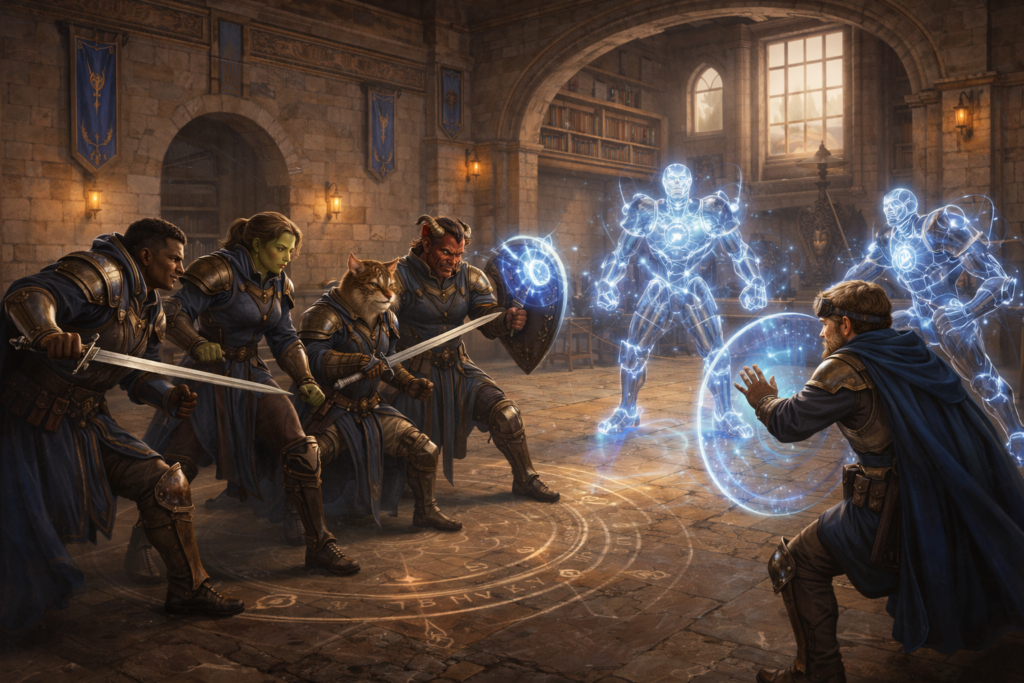
A Sample Day of a Cadre
A cadre’s day begins at dawn.
Students wake together and are given a short period of personal time—roughly an hour—to prepare for the day ahead. This time is unstructured. Some students train quietly, others review notes, repair equipment, or simply gather themselves before instruction begins.
Breakfast follows, taken as a cadre in a common cafeteria. Meals are practical and communal. Attendance is expected. Conversation is unrestricted, but absence is noticed.
The morning is devoted to group training. Cadres train together in combat drills, coordination exercises, and applied skills designed to reinforce teamwork under pressure. These sessions emphasize communication, positioning, and adaptability rather than individual performance.
Late morning transitions into individual instruction. Students attend lessons based on their developing strengths and weaknesses, while their cadre members pursue parallel instruction elsewhere. Though separated, progress is tracked collectively.
Lunch is taken together, again as a cadre. As with breakfast, this shared time is considered part of training. Observers note not only what is discussed, but how the group functions when instruction pauses.
After lunch, students are given a brief period of free time—approximately one hour. This time may be used for rest, informal discussion, or personal preparation.
The afternoon brings additional instruction. Depending on the lesson, students may work independently, in pairs, or in small groups of two or three. These sessions often focus on problem-solving, negotiation, research, or scenario analysis rather than physical training.
As evening approaches, the cadre reconvenes for study hall. This time is structured and supervised. Cadre members review the day’s material together, cross-check understanding, and prepare for upcoming evaluations.
Dinner follows, taken as a group.
After dinner, cadets are granted a longer period of free time—typically two hours—with one condition: it must be spent together. How this time is used is left to the cadre. Some groups train informally, others talk, plan, argue, or decompress. What matters is not productivity, but cohesion.
Before nightfall, students are given a final hour of independent free time. This is the only portion of the day reserved entirely for individual use.
Cadres sleep in shared bunk areas. Privacy is limited. The arrangement is intentional.
The day ends as it began—together.